
🕵🏻♂️ Field events/conference playbook
How to engage target buyers with field events and prevent your sales reps from being ghosted after.


In this issue:
The honest take why field events fail
Out 5-steps playbook for planning a proper field event
How to engage your target buyers pre-event, on-site, and after the event to ensure they actually reply to your sales reps
The fastest way to turn event leads into a pipeline

Most event teams don’t lose ROI on the event floor. They lose it in the 7 days after.
Badge scans give you a name and a title. They don’t capture what was actually said. So leads sit in a spreadsheet, get uploaded to a CRM a week later, and by the time a rep follows up — the context is gone. The conversation is cold.
Blinq closes that gap (learn more here: https://blinq.me. It captures the lead, enriches it automatically (email, phone, LinkedIn), and records conversation context with an AI Notetaker — in real time. Everything syncs to your CRM the same day, not the same week.
A year ago, we started working with a team that wanted to penetrate the UK market. They had been organizing a series of business lunches and dinners, inviting CTOs from their strategic accounts for roundtable discussions on industry challenges and best practices. The company would typically send one or two sales reps to join the event, plus one local host (from the UK).
When we met for the first time, they said: the events are not working for us.
When I asked why, they said that attendees were ghosting them after the event. So we started digging into their event playbook, and immediately uncovered three fundamentals problems.
1. Quality of the notes
First, all insights and notes from the conversations were living in sales reps’ notepads. What complicated it is that it usually hosted 2-3 events in different cities during one week. They could only work on the notes and follow-ups a few days later when they returned to the office. But most of the context and important insights were lost by then.
2. Timing
The second problem was that the sales reps were blocked by the RevOps team to do timely follow-ups. RevOps needed to enrich the attendee list and update HubSpot before sales reps could actually follow-up.
By the time follow-ups were going out, it was usually ten to fifteen days after the event. The momentum was already lost.
3. Misunderstanding of the intent
But the last problem was way more profound, and was the root reason of being ghosted afterwards:
Assuming that everybody who showed up for the event is a warm prospect, and is ready to buy. More on this below.
If you think that this was the problem of only this company I’ve mentioned above, it’s far from being true. Every team we’ve been working with that was doing field events or going to conferences (who is not going today? :) had these problems.
The conference playbook is, obviously, slightly different, but the problem remains the same:
The team is sponsoring the booth, sales have conversations at the stand, and then being ghosted after following up.
Work with us:
Need help with building/refining ABM motion? Book a free strategy session: https://fullfunnel.io/consulting/
Want to learn ABM? Join our academy: https://fullfunnel.io/academy/ or buy our book: https://fullfunnel.io/full-funnel-marketing-book/
Want to get your product in front of B2B marketing leaders (we have 98k followers combined on LinkedIn + 27k subscribers on Substack)? See the formats and book a call here: https://roiplan.replit.app/
The honest take why field events fail
Den Kozlov, SVP Strategy at Influ2, nailed down the core problem (click the image to read the entire post):

He just pointed out the false belief we are all aware of: confusing desire to learn and engage with the desire to buy.
The best analogy for me personally is dating. If you go on a first date, you probably won’t propose. Because if you do, and the other person awkwardly says “let me think about it,” the whole story becomes a cringe. Every follow up “Have you thought about my proposal?”, “Any updates?”, etc. would rather motivate the person to block and ignore you, or, rather, call a police for being stalked 🙂
But the same literally happens during and after the events. Two things go wrong in parallel.
First, we misunderstand the real level of relationship and vendor awareness with the people we’re meeting for the first time. For many attendees, this is the first awareness touchpoint with our company. We can either leave a positive impression and continue a relationship, or motivate them to start ghosting us. The more pushy the sales rep, the more likely the prospect who meets you for the first will be ghosting him.
Second, we treat the event as a stage in a linear buying funnel. As if meeting someone offline means they’re sales-ready. They agreed to show up, not to buy. The event is one touch point in a longer nurture cycle, not a place for conversions.
As a consequence, the entire playbook is not optimized at all with the buyer journey.
If you playbook is just:
Hosting a field event, bringing people there, then pitching and following up afterwards almost always fails.
Sponsoring the conference, sending a list of attendees to sales, driving traffic to the booth, scanning badges, then pitching and following up afterwards almost always fails.
Below I’ll share a playbook we use with our clients to help sales reps get a great engagement before, during, and after the event, and ensure target buyers would be actually replying.
*You can learn about it and get step-by-step guidance in our academy: https://fullfunnel.io/academy
Our 5-steps playbook for planning a proper field event
Before diving into a playbook, here are two fundamental rules:
Field events and conferences are part of a continuous, long-term nurture cycle, not a conversion touchpoint. Learn more here about optimizing playbooks for long sales cycles: https://fullfunnel.substack.com/p/how-to-create-playbooks-for-long
You must adjust your CTAs to the level of engagement, relationship, and awareness you have with that person and account in general. If you’re meeting someone for the first time, you’re not pitching them, but think about how to continue the engagement. If you have accounts that are close to the pipeline, multi-threaded, with good engagement and known challenges, that’s your opportunity to deepen the relationship and come up after the event with a personalized solution.
Now, let’s dive into our playbook.
Step 0: Content and narrative planning
From my point of view, most B2B companies simply skip this step, or don’t plan it properly.
What usually happens is that after a speaker and dates are confirmed, the speaker on his own defines the narrative and prepares the slides. Marketing just runs the promotion of the event.
But then, the quality of the presentation might be completely far from what target buyers are actually interested in. Speakers often underestimate the level of seniority and maturity of the buyers, deliver basic things, and then literally don’t leave a space for sales for meaningful follow-ups.
If the presentation doesn’t address a concrete challenge, use case, or jobs-to-be-done of a target buyer, your event is done.
I always ask clients:
Imagine you had thirty minutes with your ideal buyer from your best strategic account. This person is not currently in the market, not looking for solutions, and may not even be prioritizing the challenge your product solves.
Are you going to pitch them, or are you going to help them understand why the way they’re doing things right now is costing them? Why does change make sense now? And what the step-by-step path forward looks like?
The goal of your presentation is not to get someone to buy. It’s to help them think: this seems like a really good solution for my goals. You present a solution in which your technology is a central part. But you create a mental bridge from where your buyer is now currently to what they’d be doing to come to the desired outcome.
The only way to prepare this narrative is joint planning between marketing, sales, and the subject matter expert (who usually is a speaker). This planning includes:
One specific use case you want to address at this event
The primary persona who might care about this use case
Their biggest challenges they have
The misconceptions, false beliefs, or old approaches they’re still relying on
The questions they likely have about a better solution
A step-by-step roadmap that helps them connect the dots: this is my problem, this is why it’s happening, and this is how I solve it
Once you have this narrative, your promotion assets, messaging, and outreach become aligned with it. This is how you become relevant and allow sales reps to have meaningful conversations after the event.
When you nail down the narrative, you can move to the execution
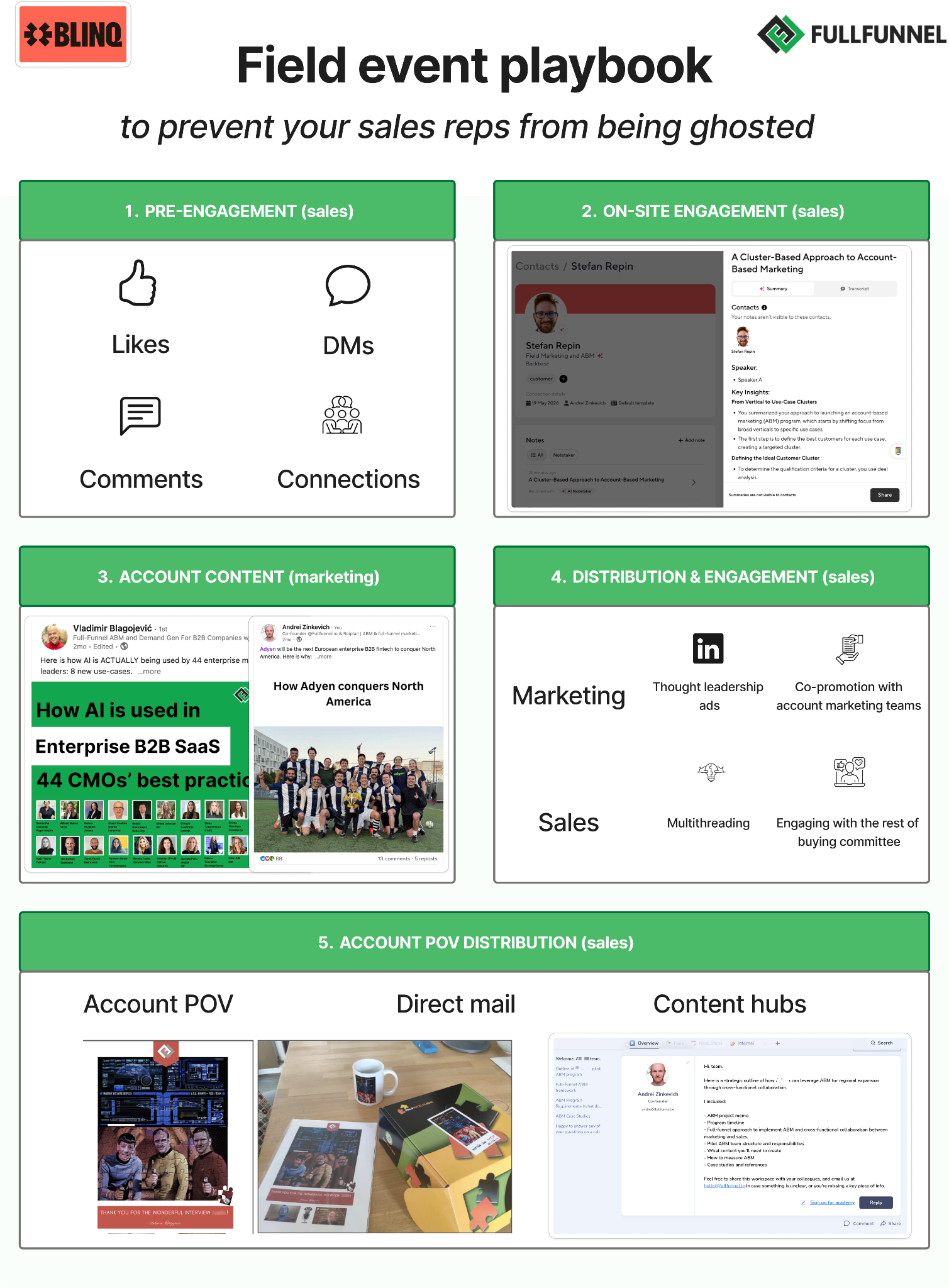
Stage 1: Pre-event engagement
This stage is owned by sales. The goal is to create basic familiarity before the event, so prospects are recognizing you when they see you in the room.
There are two scenarios:
If you have a speaker at the conference or field event
Sales reps can reach out to target buyers from strategic accounts on LinkedIn, connect, and start commenting on their posts to create visibility.
Then reach out directly, saying something like:
our CTO is speaking at this conference on [topic], and I’m collecting questions from senior CTOs to make sure the talk actually covers what matters. Would you be open to a quick coffee while we’re both there?
Marketing supports by boosting relevant content thought leadership ads to target accounts (ideally published on a sales rep profile).
If you only have a booth
Sales can reach out asking what sessions the prospect plans to attend, or which sessions they’d recommend, framing it as: I’m going with my team and wanted to ask senior peers like yourself what’s worth attending. Then ask if they’d be open for a coffee.
Stage 2: On-site engagement
When you meet prospects in person, avoid the product pitch. Instead, ask if they’d be willing to contribute to a new article or piece of research by sharing their best practices or perspectives on the topic you’ve been covering.
The most credible content today is user-generated. Not only does it help to engage buyers, it gives you a good reason to follow-up after the event.
What’s really important here is recording the conversations to avoid losing context.
We now use the Blinq, the AI contacts app (try it here) to automatically capture and transcribe the buyer’s voice, create short quotes, and transfer everything to the CRM. Blinq handles AI enrichment and has a direct integration with HubSpot.
Stage 3: Content preparation
While sales reps are traveling back, marketing can already work with the notes and insights. They can prepare:
A LinkedIn carousel with quotes from the attendees who shared their perspectives with sales reps
A LinkedIn post tagging everyone who participated
An updated article on the website incorporating the perspectives and best practices from everybody who contributed
An account brief for each strategic account: key initiatives, challenges, buying committee mapping, historical interactions
One optional tactic we use occasionally: an account love letter. A short piece of content about the strategic account, written in a journalistic style, highlighting some of their recent achievements or strategic projects.
Stage 4: Distribution and engagement
Sales publishes the carousel with the quotes, sharing the post with the entire buying committee, not only with the contributors. It helps create internal awareness.
Buyers love it. They are trained to be pitched, but here it is a completely different playbook. It creates a feeling: “these guys are normal”. But another point is that it creates a great engagement from all of your target buyers. They might be commenting, reposting, or sharing it internally which just accelerates awareness among all other accounts.
Next, if there was an agreement to have a call, remind the prospect about it. If no call was agreed upon, move to the next step.
Marketing supports post-distribution with thought leadership ads targeting all accounts.
Stage 5: Different CTAs for different buyers
Now is the most important part.
As I mentioned earlier, trying to pitch everyone after the event is a guaranteed way to be ghosted. You need to segment all accounts by the level of relationship and opportunity likelihood. Then, define the next best call to actions to each group.
For the first-time contacts (Future Pipeline):
Don’t pitch them. Instead, start involving them into the upcoming activities to strengthen the relationship and validate their needs.
For Active Focus accounts (with strong relationship and known challenges):
Based on account research and brief, the sales rep prepares a one-page account POV (point of view). Next, they publish an account love letter, sending a link to it and a one-pager document mentioning that if it’s helpful and relevant, they would like to have a call.
But don’t aim for a discovery. Depending on the known context, think about:
What might be the best help for them right now?
Sometimes, it can be a conversation with your power user who was dealing with the same challenges in the past and has successfully solved it. Sometimes, it can be a free audit or consultation with your solution architect to identify the root problems and plan a roadmap.
The goal is to give people a reason to keep engaging, matched to where they actually are.
—
Almost every company we’ve worked with has complained about low reply rates after the events.
My honest take: it happens because the small talk during the events is not part of a continuous relationship but rather one-off transactional conversations. Many buyers are too polite to say “no,” so they agree to have a call after the event but then ghost sales reps.
Drive pipeline THIS quarter with full-funnel ABM programs.
If any of these challenges sound familiar:
You are aligned in theory with sales but don’t do anything in practice aside from receiving wish lists from sales and sharing with them your marketing plan. In reality, you work in silos and miss the revenue targets and are being pressured by your executives.
You understand that your marketing and sales playbook is broken (mqls, gated content) but despite many attempts you don’t know how to fix it
Your outbound, paid ads and organic pipeline drastically decreased while CAC increased mostly because most of your market is problem unaware and not buying.
You lack brand awareness among target accounts and sales can’t get even a reply.
You clearly see that you’re already behind your revenue targets
We can help.
We’ll develop a custom full-funnel ABM strategy aligned with your resources, budget and stack and execute it together to drive results THIS quarter.