
🕵🏻♂️ ABM sprints
How we build a full ABM pilot in 5 days.


A few years ago, we started noticing a pattern why ABM programs with some clients don’t perform as expected. We couldn’t initially spot the problem: the cross-functional team was in place, the same methodology, and experienced people. Same setup as in our best case studies.
Until we saw a clear pattern - the extended timeline of the launch.
We looked at our best case studies and saw that with all of them we very quickly finished the pilot preparation, and went into execution. While the programs that didn’t perform well had a long, extended, pilot onboarding and prep.
Today we’ll share:
The hidden signs of failure for any long-term cross-functional program
How and why we shifted to sprints, and how it impacted our clients
How to build a full ABM pilot in 5 days
Learn how to create pilot sprints in Full-Funnel B2B marketing book
We walk you through the entire process of planning and executing a cross-functional pilot program, and show the entire breakdown of one of our campaigns.
The hidden signs of failure for any long-term cross-functional program
Here is the pattern we’ve identified: no real commitment. The team wanted to launch ABM. We had a great onboarding session, everybody was excited.
But when we started planning the next prep workshops, we regularly faced the same challenge. It was hard to get everybody involved (SDR, subject-matter experts, ABM lead, etc) on the call for multiple reasons: conference travels, time off, QBRs, business trips. There always were good reasons.
But as a consequence, the prep work that was supposed to be done in max 2 weeks, was extended to 1-1.5 months.
We wanted to be flexible and align with the client constraints, but here is what usually happened next.
After the first session which was usually about account prioritization, sourcing and capacity planning, the standard homework was qualifying sales lists, selecting other accounts, and segment all of them into 3 lists: Cluster ICP, Future Pipeline, Active Focus.
But after the workshop, the team went back to their reality. Sales had deals to work on. Marketing had campaigns to launch. Someone had a conference coming up.
ABM lead (our Champion) asked to postpone the call by one-two weeks when everybody is available.
Then we came back for the second session. Part of the group had forgotten what we discussed. Some tasks were not done. Some decisions were no longer fresh. The initiative was still alive technically, but the momentum was gone.
And with every further delay or postponed call, the program was slowly dying because:
People forgot the logic behind decisions
Priorities changed
Resources shifted
Buy-in faded
Ownership became blurry.
When I was analyzing the challenge, I came to a simple conclusion.
If we take any long-term, cross-functional program (let’s say ABM), it is a chain of decisions by multiple people from different teams. You need to define:
Strategy and leadership expectations.
Account qualification and prioritization criteria
Account selection and sourcing
Account research process and buying committee mapping
Playbooks, and how sales and marketing will work together
Reporting and metrics
Operational rhythm
Spread this across 5-6 weeks, and you create perfect conditions for failure: people forget the agreements, the logic behind the decisions, and their role and responsibilities.
This creates another problem: rush.
The longer the prep takes and the more the actual kick-off is postponed, the more frustrated everybody becomes. This leads to another problem: skipping essential parts of the playbook because of “I know how to do it”.
We know that every single team has ICP with defined buyer personas (job titles). Every sales rep says they know how to find the real buyers. But it sounds good on paper.
With one of the clients, I asked sales reps asynchronously to show me how they would find and map 10 IT buyers from Oracle (a strategic account of that client). Their processes, and, as a result, the buyers they have selected, were completely different.
Why?
Because the team has never created a structured process of identifying enterprise buyers because “everybody knows how to do it”.
I took this simple example, but the same happens with all other critical processes: creating ABM content, running account research, preparing slides for the webinar, reaching out to buyers.
Every time the team rushed and skipped the essential steps, the performance later was terrible.
We were wondering if it’s only an ABM problem and reached out to several B2B CMOs. They confirmed the same thing: whenever they tried to launch long-term strategic initiatives like thought leadership, shared marketing and sales playbooks, etc, the longer it took them to onboard the team, the poorer were the results. And the program died.
My takeaway: there is a clear correlation between how stretched the preparation and the launch process is and how the program performs.
That is when we realized we needed to change how we do the ABM pilot preparation. The problem wasn’t in the methodology, delivery, or documentation, because we had a lot of great case studies.
The problem was in extended launch time which led to lack of commitment and program deprioritization.
We went back to two books we really loved and took a lot of ideas from: Sprint by Jake Knapp and John Zeratsky, and Scrum by Jeff Sutherland.
Both make the same core argument from different angles:
Sprint: compress months of planning and debate into a single week, and end with a working prototype.
Scrum: only commit to what the team can realistically execute, review and adjust weekly, and keep sprint cycles short and focused.
The logic of both books is the same: short, time-boxed, focused work produces more real output than extended planning cycles. The team that builds something together during a short focused period of time and invests a lot of resources, commits to it differently and performs better.
This is how we moved to a 5-day ABM design sprint for the pilot preparation and team onboarding, and 90-day execution sprint incorporating best practices from Scrum.
Learn how to launch full-funnel ABM program in Full-Funnel Academy
Inside the academy you’ll get access to all our playbooks and on-demand courses: full-funnel ABM, ABM on LinkedIn, brand awareness and demand generation.
Academy also gives you free access to our virtual workshops (the recent one was account prioritization workshop) + direct feedback from Andrei and Vlad.
The pilot sprint format
We tried different formats, and ultimately figured out two best formats.
1. The 3-day in-person format
This is the more intensive format, but it usually produces the best results because of commitment and no distractions. The team travels to one location and works together for three full days in one room on the full pilot setup + runs the processes together.
Because everyone is physically in the same room, the pace is faster, the conversations are more direct, and the energy stays higher. There is no logging off, no context switching, no Slack notifications pulling people away.
When a sales rep and a marketer are sitting next to each other reviewing a real account in Sales Navigator, the quality of the conversation is completely different from the one that happens over a shared screen. You see what the other person is looking at. You react in real time. Decisions get made in minutes instead of async threads.
This format works especially well when the pilot team is small: a program lead from marketing, one or two sales reps, and ideally a subject-matter expert. Three days is more than enough to prepare the entire pilot and ring a few processes to show the pilot in action when the team is fully locked and the agenda is tight.
2. The 5-day virtual format
When it’s not possible to gather the team in one place, we spread the same work across five days of three to four hours each. The sessions are focused and structured ( not full-day Zoom marathons), and the extra time between sessions allows the team to complete small tasks and come back with output the next day.
For example, after defining the account research process on day two, each team member can research one account overnight and bring their findings to day three, where we review them together and refine the process based on what they found.
Both formats end in the same place: a complete pilot program, a leadership presentation, and a team that knows what to do starting the following Monday.
How we run the ABM design sprint
To share with you a concrete example and outcomes, here is how we run the 5-day ABM design sprint. The core principles:
Each step builds on the previous one
Practical execution: every decision is made against real accounts, real buyers, and the actual team that will run the program.
Here is the entire breakdown.
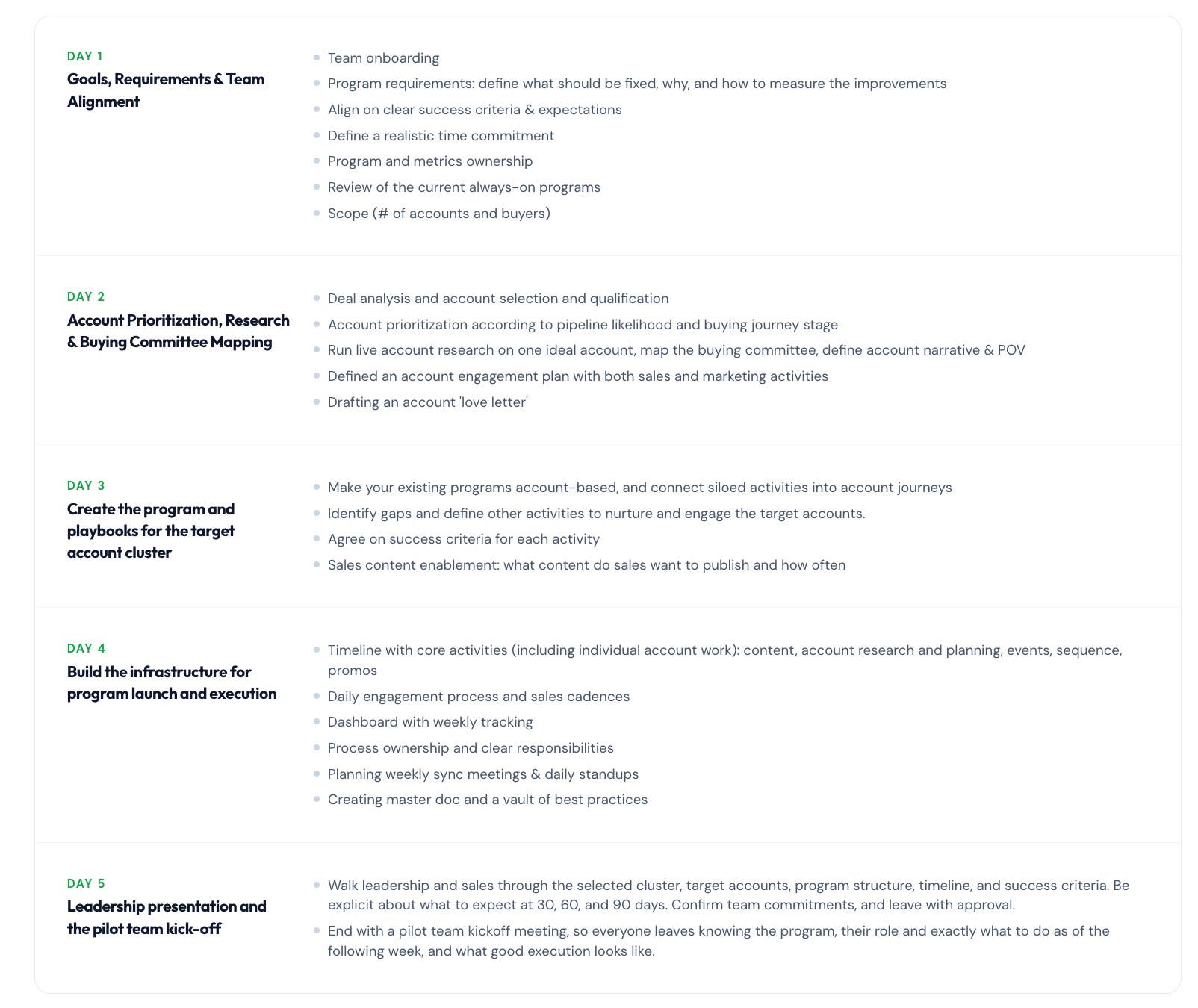
Day 1 — Goals, requirements, and team alignment
We start by defining what needs to be fixed, why, and how we will measure improvement. We align on clear success criteria and expectations. Not what leadership hopes for, but what is realistic given the team’s bandwidth, the number of accounts, and the sales cycle.
We review the current always-on programs to understand what marketing is already running, and we define the scope of the pilot: how many accounts, how many buyers per account, and which cluster we are targeting. We also define who owns what: specific responsibilities for each step of the program.
Usually, at this stage we define the lowest hanging fruit and the reason for marketing and sales misalignment.
When we review the existing always-on programs alongside the sales account list, we find that marketing’s programs are not covering the accounts sales selected. Webinars are promoted to a general audience. Content is distributed broadly. Paid campaigns are running against ICP personas, not named accounts. Sales and marketing have been operating in parallel, not together.
Just making this visible and deciding how to make an existing program account-based is one of the most valuable things before the program kicks off as it leads to the alignment.
Day 2 — Account prioritization, research, and buying committee mapping
We run the deal analysis together: using the top five wins and top five losses from the target segment to define what a truly qualified account looks like. Then we combine marketing’s first-party engagement data with sales’ territory plans and qualify accounts together. The result is a shared, prioritized account list that both teams have agreed on.
Then we do the account research process live, using a real account from the list:
What information do we need?
Where do we find it? Company website, LinkedIn, annual reports, recent press releases, job postings, community activity?
How do we document it, and where?
How will this research shape the messaging and the plays?
Most teams we’ve been working with have never defined this as a process. Every rep does it differently, and none of the output is accessible to marketing. Running it together on a real account helps the team to create a workflow with the benchmark research they can replicate.
This is also where we address buying committee mapping, which is one of the most painful and underestimated problems in enterprise ABM.
When sales reps open Sales Navigator on their own, they filter by seniority and job title and end up with a long list of possible stakeholders: VP of IT, Director of Infrastructure, CTO, Head of Digital, Enterprise Architect, Transformation Lead.
Without a clear process for mapping those roles to the specific initiative they are trying to influence, they choose based on gut feeling. In the sprint, we fix this together.
We define the keywords. We agree on the filters. We work through Boolean search logic live. We review real profiles from the target accounts until we have a shared, repeatable process for identifying the right buyers. As a result, further buying committee mapping becomes a standard and predictable process.
The day ends with drafting the first account love letter together: a personalized, non-sales piece of outreach that shows the target account you have done the homework on their business, their initiatives, and the specific challenges relevant to your value proposition.
By writing it together and distributing it, the team moves from theory to execution. But the best part happens when the sales reps receive the replies in the next few days. This is what creates the real momentum.
Day 3 — Program and playbooks for the target cluster
We review the scheduled marketing and sales activities (events, content, etc) we decided to make account-based and put them on timeline. For each of the planned activities, we define:
the buffer time for promotion
the promotion playbooks for strategic accounts
marketing and sales responsibilities
success criteria
When finished, we review if we have any gaps in the timeline. If yes, we decide what additional activities will be included in the pilot, and add them.
Day 4 — Infrastructure for program launch and execution
During this day we work on reports and dashboards, and operational rhythm.
We usually set up the dashboard with three types of metrics:
account velocity (accounts moving between lists),
leading indicators (activities the team controls week to week),
lagging indicators (replies, meetings booked, opportunities created).
*Learn more about measuring ABM here: https://fullfunnel.substack.com/p/abm-kpis-and-reports
Then, define the daily engagement process, set up the weekly sync meeting structure, and agree on what accounts we’ll start engaging first, so the meeting ends up with an actionable plan.
Last step: preparing a presentation for the leadership to onboard them on the program and set up the right expectations.
Day 5 — Leadership presentation and pilot team kick-off
On the last day, together with the pilot team we present the full program to the leadership: VP Sales, CEO, and other C-suite who need to approve resources and commitment. The presentation covers the selected cluster, target accounts, program structure, timeline, and what to expect at 30, 60, and 90 days.
What makes it great is that we can show the real work done during the sprint: drafted account love letters, mapped actual buying committees, tested outreach angles on real accounts. Often, there is already an early small win to show: an engagement from a strategic buyer, a reply to an outreach, etc.
Real results are the best proof of concept. Leadership sees that the program already has structure, committed people, and proof of concept.
After the leadership presentation, we review the program kick-off:
The plan for the next week including accounts we are going to research and engage
Tasks and responsibilities
Last minute questions
The goal is to make sure that the team is fully ready for the kick off.
Why pilot sprints work
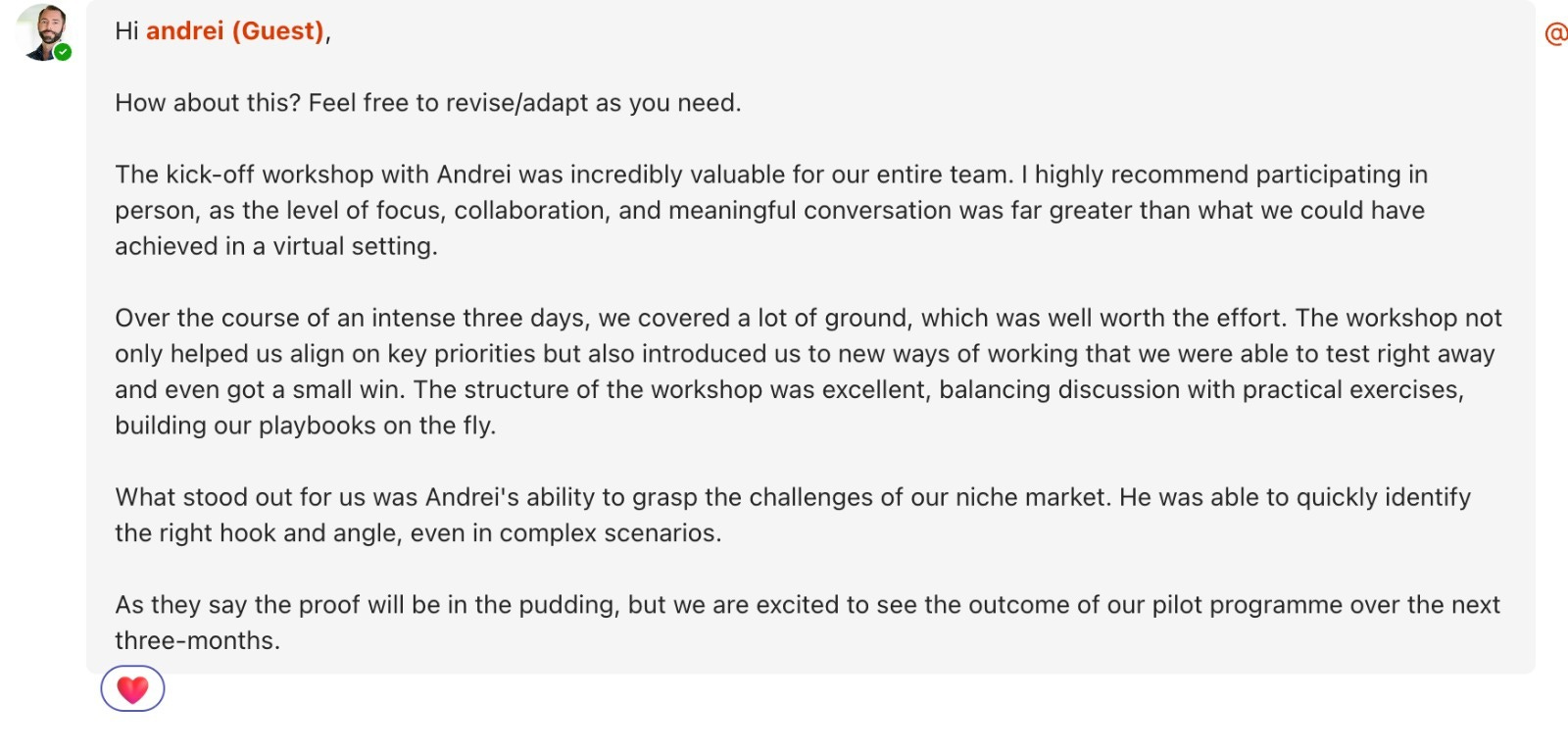
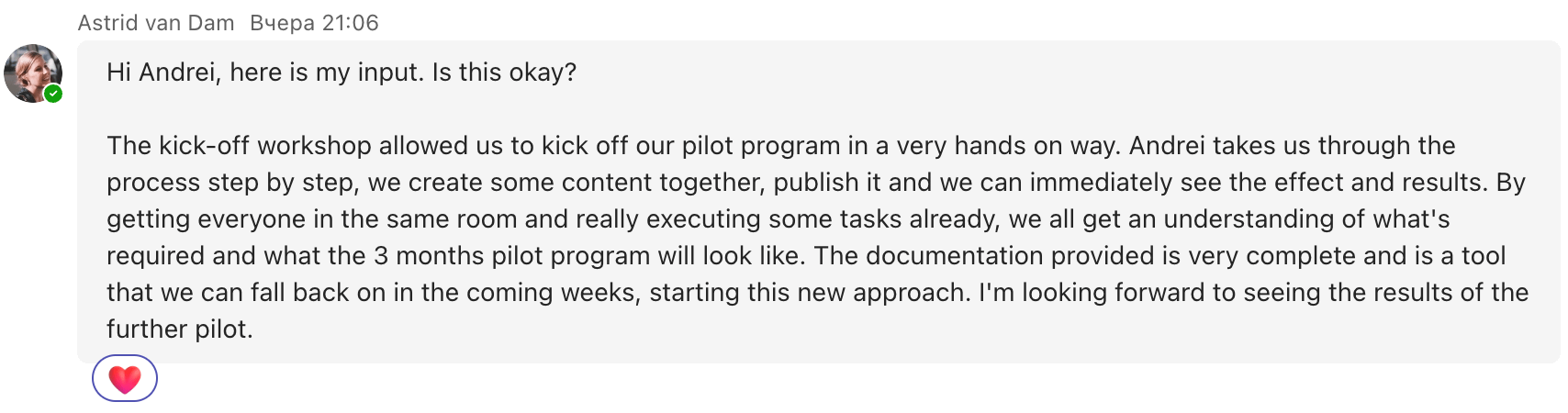
We tested both 3-day in person ABM sprints with Customs4trade and and 5-days virtual sprints with Benchprep teams first.
I’ve asked about the feedback. Here are the unpolished versions.

My takeaway:
The real alignment and understanding happens only when the teams strategize, plan and execute together during a short sprint. You go from theory to execution, see the early positive signals, and know already that the program works.
You might be wondering: what happens after the pilot sprint prep and if the time investment has a good ROI?
Let’s look at the results of both teams.
What happens after the sprint
To maintain the pilot execution, you need to book a weekly 60-minute pilot sync meeting for the pilot team ideally paired with 10-15 mins daily standups.
The agenda of the meeting is simple:
what worked last week
what did not
what accounts are showing signal
what the team will do next week
what is blocking execution.
No stakeholders outside the pilot team. No status updates for the sake of it.
This meeting does two things. It keeps the team accountable to what they committed to during the sprint. And it helps to identify bottlenecks before they lead to program failure.
For the full structure of how to run these meetings, track the pilot dashboard, document what works, and present the retrospective to leadership, we cover it in detail in our Full-Funnel Marketing book.
Here is what the 90 days produced for two teams who ran the program after their sprint.
BenchPrep
Briana Manrique (Sr. Director of Marketing), Megan Barenie (Marketing Manager), and Jalynn Close (BDR) ran a 90-day pilot against 60 strategic accounts in the professional associations and credentialing market.
After 90 days:
40% of accounts moved from vendor unaware to vendor aware
12% moved to active focus
3 qualified sales opportunities generated.
And after the campaign ended, inbound demo requests continued coming in from accounts in the pilot cluster.
Briana mentioned: “I think we successfully moved about 40% of our accounts from being totally vendor unaware to vendor aware, meaning they had some sort of engagement with us. And then about 12% of accounts moved from that stage to what we call the active focus, which was where there was an expressed intent or some sort of expressed buying need.”
Another point worth repeating: “It’s a long play, so something for folks to keep in mind, you’re not gonna see necessarily results right away. The sprint gave the team a complete, runnable program. The results came from the 90 days of disciplined execution that followed”.
Read the full case study: https://fullfunnel.substack.com/p/lean-abm-new-abm-case-study
Customs4Trade
Joseph Threlfall (Field and Partner Marketing Manager), Bowin Cai (Account-Based SDR), and Raf Schroons (Senior AE) ran a 90-day pilot targeting enterprise accounts in customs automation and supply chain. Their sales cycle runs over two years. Their buyers had historically ignored cold outreach entirely.
After 90 days:
10 discovery calls booked with enterprise accounts. 2 of them were the accounts they tried to book a call for the last 2 years. Joe mentioned: “There were some accounts that we had been reaching out to that had never responded via LinkedIn, for example. And then suddenly they start waking up.”
29 accounts progressed to active focus, up from 4 at the start of the pilot. Bowin mentioned: “We’ve begun creating an attack plan for large accounts instead of just contacting a single key decision-maker like we did before. But in large multinational companies, decisions aren’t made by just one person, of course.”
63 future pipeline accounts that hit the engagement threshold.
LinkedIn reach went from 600–800 impressions per post to 200,000 impressions in the final month.
But these results wouldn’t be possible if the team didn’t co-create the entire program together, knew how to execute it, and maintained operational rhythm.
Drive pipeline THIS quarter with full-funnel ABM programs.
If any of these challenges sound familiar:
You are aligned in theory with sales but don’t do anything in practice aside from receiving wish lists from sales and sharing with them your marketing plan. In reality, you work in silos and miss the revenue targets and are being pressured by your executives.
You understand that your marketing and sales playbook is broken (mqls, gated content) but despite many attempts you don’t know how to fix it
Your outbound, paid ads and organic pipeline drastically decreased while CAC increased mostly because most of your market is problem unaware and not buying.
You lack brand awareness among target accounts and sales can’t get even a reply.
You clearly see that you’re already behind your revenue targets
We can help.
We’ll develop a custom full-funnel ABM strategy aligned with your resources, budget and stack and execute it together to drive results THIS quarter.
TLDR
A lot of great initiatives that require cross-functional collaboration (ABM, sales-marketing playbooks, signal-based playbooks, buyer enablement) often fail at the launch stage. There is a good vision and strategy behind the initiative. But what kills it is that the launch process stretches over weeks.
Momentum is decaying. Priorities are shifting. People become distracted. And the program slowly dies.
Three years ago we faced this problem ourselves and changed how we roll our ABM programs with the client using sprints.
The first part is preparation done with a cross-functional team in 3-days in-person or 5-days virtual sprint. Then, quarter execution.
This helps you to lock the team, compress the entire program design into one week, present it to your leadership, and have a team that knows exactly what to do starting from the next week.