
🕵🏻♂️ How to audit your ABM program w/scorecard
How to evaluate the efficacy of your program, identify the gaps, and compare it to the conversion benchmarks.


“We’re doing ABM already—we have a named account list that our sales team is targeting and our marketing team is trying to get in front of them. But conversions could be better. How can we refine it? “ - just this month I’ve heard this from 7 B2B CMOs on the discovery call.
Technically, targeting the same list of accounts sales prospecting can be called account-based marketing. But there is a huge difference between doing ABM and doing ABM WELL!
This problem was brilliantly described by Jaleh Rezaei (co-founder Mutiny):
“ABM is the ‘Teenage Sex’ of the new decade—everybody talks about it, few are actually doing it, and almost nobody is good at it.”
And there is a reason for this: all of us learned about ABM through completely different experience.
Most of B2B marketers I know learned about ABM from content created by ABM technology vendors that created a certain understanding of how ABM should be done (and technology should be a core part of it).
While I (Andrei) learned it the hard way being in the trenches. I worked in enterprise sales and marketing for 8 years at Kimberly Clark where our market was limited to about 50 core retail chains, with annual contract values from $500k to $50 million per year. Vlad worked as solution architect (technical sales) at Sony, and we developed a very different understanding of what good ABM looks like compared to what is shared by technology vendors.
Today we are going to share:
How to evaluate if you’re running ABM program according to best practices
How to identify the gaps in the ABM program that lead to poor performance
How to evaluate ABM program efficacy with leading and lagging indicators, and pipeline metrics
🚀 Turn your LinkedIn into your #1 growth channel.

Meet our partner of today’s newsletter- Playbookz .
Playbookz helps CEOs & execs build a strong personal brand without writing a word. Last year, clients reached millions and connected with hundreds of leads through ghostwriting, lead magnets, and amplification.
✅ 60 min/month
✅ Done-for-you, white-glove content
✅ Hundreds of qualified leads from single posts
Get 20K views in 28 days or don’t pay. Our readers get $1k off their first month with the link below.
Auditing your ABM
Here is an ABM audit scorecard with 6 core areas of ABM where most B2B companies fail (or not running these areas well). Below we’ll share the difference between low and high efficacy processes, and how to fix it. At the end of the newsletter, you’ll find this scorecard with the score interpretation.
Let’s dive in.

1. Account List Building & Selection
Current State Assessment
Account Sourcing
Where do accounts come from? (Sales lists only, or CRM + intent + engagement data?)
Are lists static or dynamically updated?
List Size & Segmentation
How many total accounts are in your ABM program?
Are accounts segmented by priority level?
Is the number of accounts prioritized for 1-1 engagement aligned with ABM team (and especially sales rep) bandwidth?
Account Qualification Criteria
Do you have documented account qualification criteria?
Do you have disqualification criteria?
Was this created jointly with sales?

2. Account Research
Current State Assessment
Process Documentation
Is there a standardized account research process?
Does every SDR follow the same process?
Research Questions
Are research questions documented?
Is it clear WHY each piece of information matters?
Is it clear HOW to find the information?
Is it clear WHERE to store the information?
Information Storage
Where is account research stored? (Sales files, CRM, scattered?)
Is there a 360-degree view of each account?
Research Usage
How is research being used beyond personalized outbound?
Low Efficacy Indicators ⚠️
Source: Sales planning
Number of accounts: 100s
List update: Static
Account prioritization: “Big accounts we want to win.” No clear ICP, brand awareness or evidence of the product need.
The most common mistake happens right here. Usually, sales shares their lists with marketing with a short context: “These are the industries we’re focusing on and these are our target accounts.” I remember speaking to one sales director about how their sales lists were built. He said: “We just take the biggest accounts in our territory.” That’s basically it.
The biggest problem here is that these lists are built usually based on firmographics criteria without any evidence if these accounts are in the market (or will be soon). Another problem is that often these accounts are completely cold (no brand awareness) and not researched, so market is supposed to “create awareness” with a broad messaging and content. And I have never seen it’s working successfully.
These lists are big, static and are not reviewed until the next sales planning. They completely ignore intent data, account engagement and signals. All accounts are engaged the same way unti the discovery call is booked.
Lastly, this setup ignores the team (and especially sales rep) bandwidth.
We often forget a simple math. If your sales rep must engage 10 different buyers per account, and your SDR has 50 accounts, that’s 500 people. And if this sales rep has other responsibilities, your mission is impossible.
The only engagement that would be done is automated outbound.
High Efficacy Indicators ✅
Source: CRM + intent data + engagement signals
Number of accounts:
Active Focus: 1-10 accounts (SDR + AE, 60% time)
Future Pipeline: 20-50 accounts (SDR, 40% time)
Cluster ICP: Broader pool for awareness
List update: Weekly based on engagement and signals
Account prioritization:
Level of awareness (Do they know us?)
Evidence of need (Do we know what is their high priority need?)
Relationship status (Active conversations?)
Action Items to Fix
Step 1: Conduct deal analysis for target use case/segment
Extract 3-5 biggest and fastest deals (last 12-18 months)
Extract 5 recently lost deals
Identify patterns and characteristics between your best accounts and lost deals
Step 2: Define account qualification criteria
Firmographics and technographics (size, industry, location)
Account qualification criteria (use the insights from deal analysis)
Buying committee structure (champions, power users, decision makers, influencers and blockers)
Account disqualification criteria
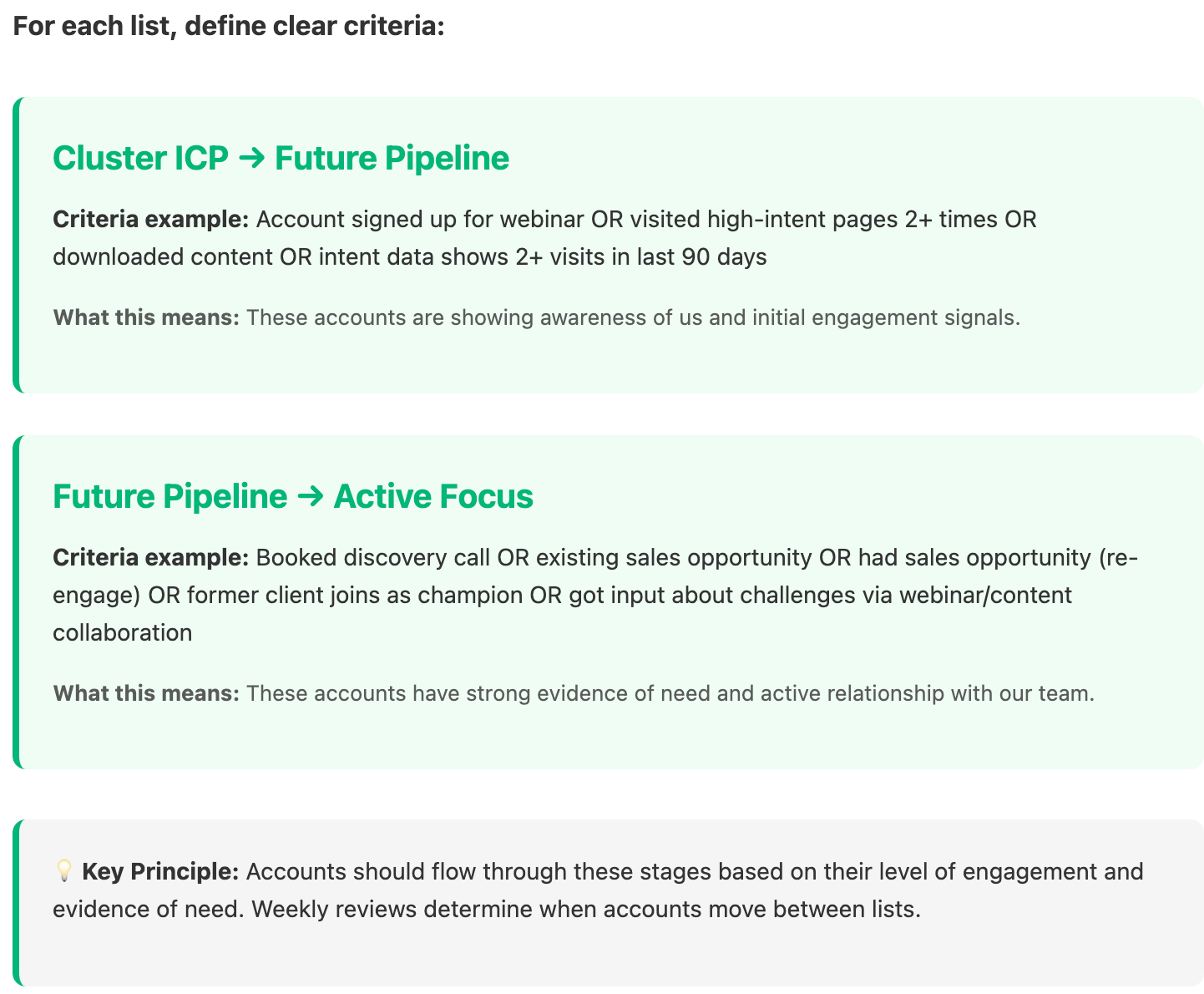
Step 3: Define account prioritization criteria
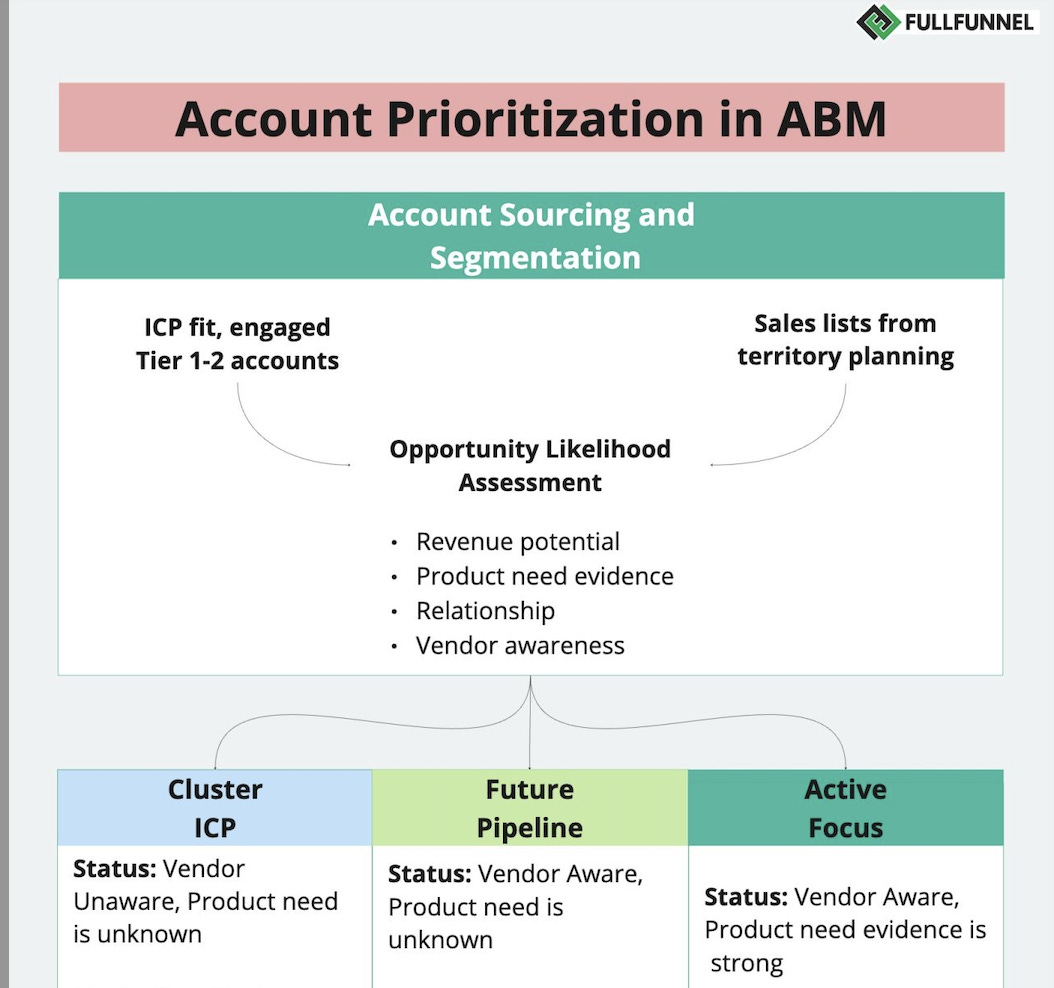
Cluster ICP: All qualified accounts, vendor unaware, product need unknown
Future Pipeline: Vendor aware, product need unknown, requires research
Active Focus: Vendor aware, product need evidence is strong, relationship exists
We have a detailed process documented in full-funnel academy.
BECOME A FULL-FUNNEL B2B MARKETER

Full-Funnel Academy is a comprehensive B2B marketing training and Slack community for B2B marketers who care about revenue and want to move the needle.
Academy includes:
All our B2B marketing courses including ABM playbook, Demand Gen Playbook, LinkedIn Allbound marketing playbook and 11 more courses that aren’t available publicly + all upcoming courses.
Private Slack community to answer all your questions
Personalized learning plan. If you are not sure what skills you’d develop in the first place and how to get maximum from the program, we can create a personalized learning plan accordingly to the time you can dedicate to education.
Behind-the-scenes sessions. See what’s working and what doesn’t work and why on the “behind the scenes” sessions where we review the campaigns we are running for our clients and us.
Learn more and join the academy here.
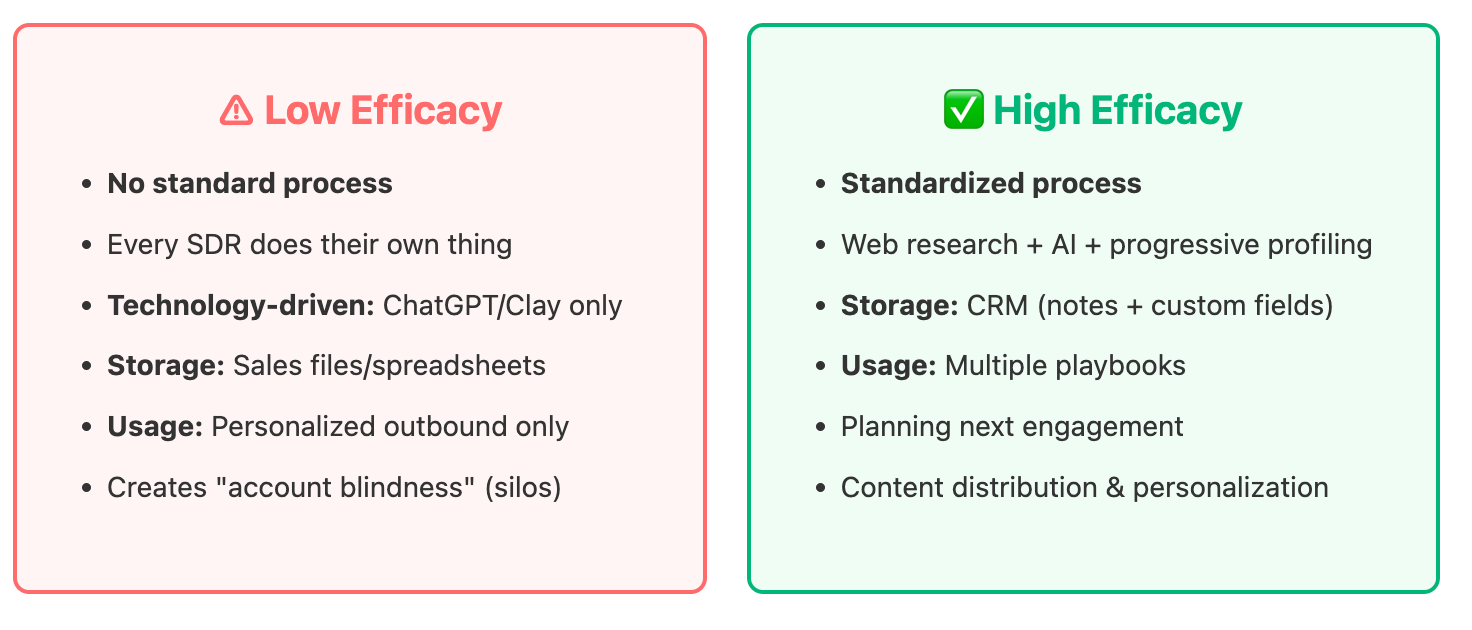
Low Efficacy Indicators ⚠️
Process: No standard and no process - every SDR runs it’s own research
Source: Technology-driven (ChatGPT/Clay)
Location: Sales files
Usage: Personalized outbound
360 account view: “Account blindness” - scattered information across teams
Every team we spoke to claims they are doing account research. Some sort of.
But these insights are scattered across multiple systems. Every SDR decides how to run the research and what info to collect. This information is rarely shared with other teams.
And we end up with account blindness - lack of a complete view of how strategic accounts interact with you across marketing, sales, and product touchpoints + all collected insights about account needs and priorities.
Often, when an SDR leaves the organization, account insights vanish as well.
The truth is: if you don’t have a standardized account research, it means you don’t have an efficient and standardized account engagement strategy. Every rep plays own game, and the efficiency of it is measured by pipeline created. As a result, company depends on a few “A” players instead of making sure everybody can follow the proven and efficient playbook.
Another inefficiency we always see - account researched is used for a personalized outbound. But everybody ignores the elephant in the room: we act on insights available for everybody and think that this is a personalization at scale.
Yes, the personalization is real, but the relevance is zero. As Jon Miller describes it: “Each prospect today gets a uniquely personalized, uniquely irrelevant email.”
Just look at the email I’ve recently received.
Is it personalized? Yes.
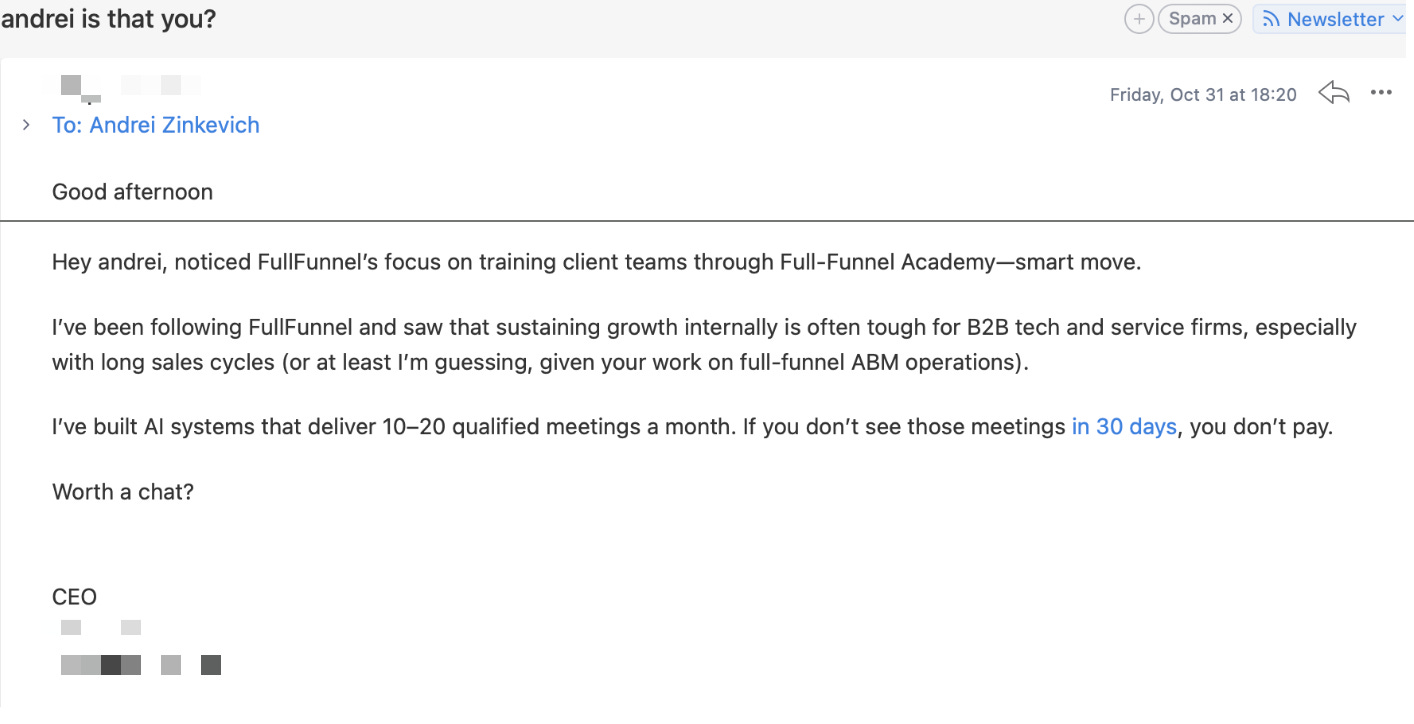
Is it relevant? Absolutely no.
Could it be done better?
For sure, if, in this scenario, this person would talk about creating better learning experience and educational portals, and send me an interesting content, instead of generic irrelevant pitch.
TLDR;
Incomplete account research and CTA misaligned with my current state as a buyer = irrelevant pitch that everybody ignores. The critical piece most teams miss: Account research isn’t for outbound personalization. It’s for:
Picking relevant content to share
Planning which buying committee members to engage next
Creating account-specific “love letters” that position you as genuinely interested
Building personalized solutions, not pitches
High Efficacy Indicators ✅
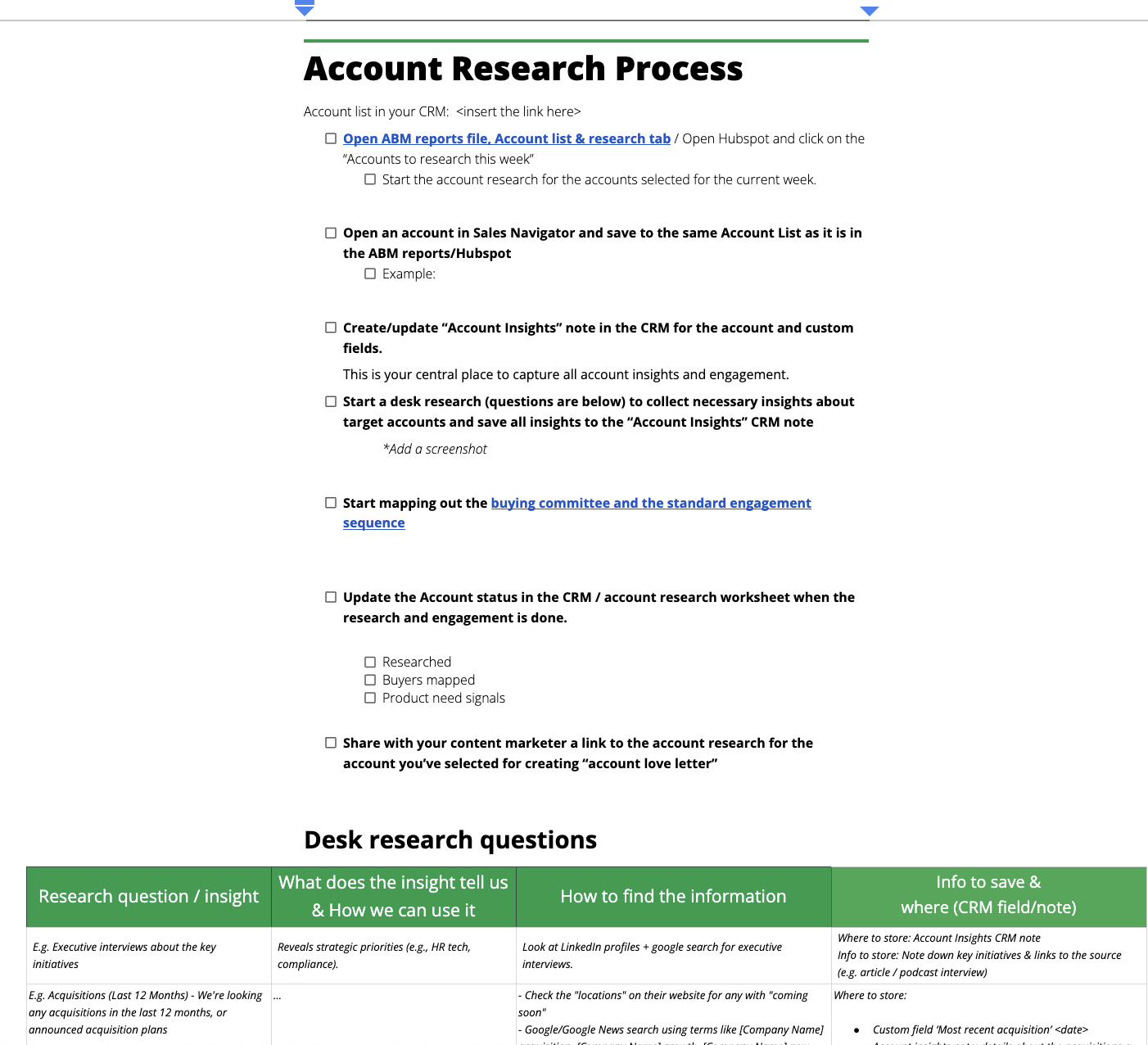
Process: Standardized research process documented
Source: Web research + technology + 1-1 progressive profiling
Location: CRM - notes and custom fields (centralized)
Usage: Planning next engagement steps, content distribution, personalized content and solutions, account development strategy
360 account view: all interactions, engagement and account insights are stored in the account card in the CRM
Action Items
Step 1: Create standardized account research process, including:
Research questions
Why this information matters (usage)
How to find the information (sources)
Where to store it (CRM fields/notes)
Include “desk research questions” for web-based research
Include “progressive profiling questions” for 1-1 conversations
Learn more: https://fullfunnel.substack.com/p/account-blindness
Step 2: Define playbooks to leverage research
Content Distribution: Sales as distribution channel
Personalized Content: Account love letters, case studies, personalized content hubs
Account Planning: Next best actions based on research
Learn more: https://fullfunnel.io/account-based-marketing-playbook/
Step 3: Train team on process
Ensure 80% accuracy across all team members
Make research process part of sales onboarding
Drive pipeline THIS quarter with full-funnel ABM programs.
If any of these challenges sound familiar:
You are aligned in theory with sales but don’t do anything in practice aside from receiving wish lists from sales and sharing with them your marketing plan. In reality, you work in silos and miss the revenue targets and are being pressured by your executives.
You understand that your marketing and sales playbook is broken (mqls, gated content) but despite many attempts you don’t know how to fix it
Your outbound, paid ads and organic pipeline drastically decreased while CAC increased mostly because most of your market is problem unaware and not buying.
You lack brand awareness among target accounts and sales can’t get even a reply.
You clearly see that you’re already behind your revenue targets
We can help.
We’ll develop a custom full-funnel ABM strategy aligned with your resources, budget and stack and execute it together to drive results THIS quarter.
3. Buyer Engagement
Current State Assessment
Engagement Approach
Technology-led or manual engagement?
Optimized for volume or quality?
Marketing Engagement
Display ads to named accounts?
Content downloads/gated content?
Generic messaging to hundreds of accounts?
Sales Engagement
Automated outbound sequences?
Manual, personalized touchpoints?
Multi-threading across buying committee?
Engagement Coordination
Are marketing and sales coordinating on engagement?
Are there joint playbooks?
Low Efficacy Indicators ⚠️
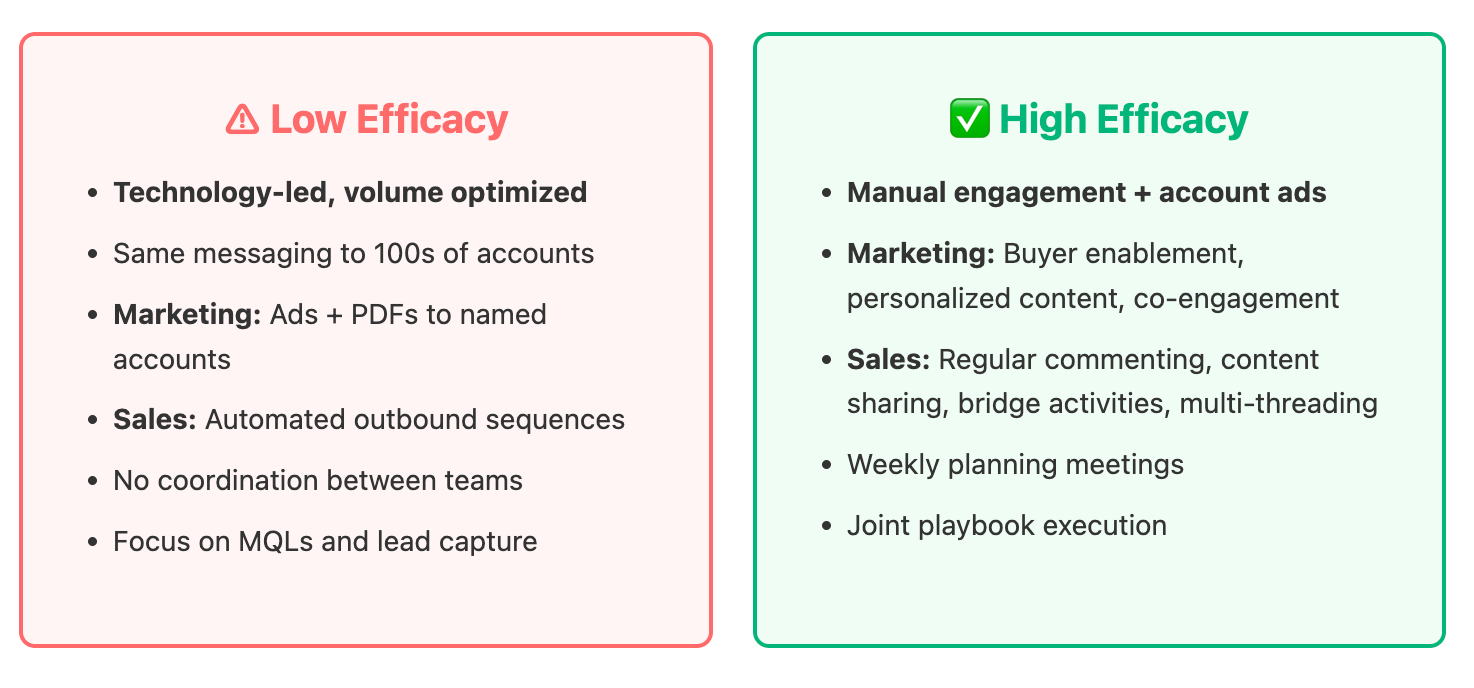
Engagement: Technology-led & optimized for volume
Approach: 1-many. Same messaging to 100s of accounts
Marketing playbook: Ads + PDFs to named accounts from sales
Sales playbook: Automated outbound sequences
Execution: siloed.
When teams do ABM, the first question they consider is not “How can we engage the accounts to create sales opportunities”, but “What can we do at scale?”.
Then marketing runs traditional air cover or MQL campaigns to sales account list (aka getting in front of them), while sales run personalized outbound at scale (see the previous point).
This conventional ABM setup fails just in a few weeks (check this post where we explain why: killing ABM).
The truth is that enterprise B2B sales and marketing is relationship-based, not volume-based. You need to be known, and you can’t be known by sending more irrelevant emails or running more ads.
We mentioned a couple of times how B2B buyers select the vendors (see this post: https://fullfunnel.substack.com/p/revenue-marketing) and why “personalized outbound at scale” doesn’t really work in enterprise environment: https://fullfunnel.substack.com/p/account-bases-sales-reps
My favorite quote about it is from Snowflake VP at Grafana Labs sales summit:
I don’t trust cold outreach at face value (doesn’t matter how personalized is it), but, if someone I trust vouches for the solution, I will take a look.
The best ABM programs that we executed always include:
1. RUN ACTIVITIES THAT GENERATE 1ST PARTY SIGNALS.
Personalized “account love letters” posted on LinkedIn that mention target accounts’ initiatives
Webinars with 1:1 invites to buying committee members and progressive profiling
Content hubs
Expert roundups featuring industry voices
Thoughtful commenting on buyers’ posts
Market research that includes target accounts
Get templates and examples of these playbooks in our ABM course: https://fullfunnel.io/account-based-marketing-playbook/
2. BUILDING ONE ACTIVITY ON ANOTHER FOR HOLISTIC ACCOUNT AWARENESS, PENETRATION AND RESEARCH
Start with account research to identify key initiatives
Move to growing your network with buyers from target accounts
Create personalized content that addresses their specific challenges
Track profile visits, content engagement, and accepted connections
Develop insights for personalized solutions based on engagement patterns
Connect insights from the activities (content -> webinar -> expert roundup -> market research -> webinar presenting market research) to have a mix of value-added touchpoints
3. USE 1ST PARTY & 3RD PARTY SIGNALS FOR VALUE-BASED TOUCHPOINTS WITH THE ENGAGED BUYING COMMITTEE GROUPS.
Monitor hiring announcements that indicate new initiatives
Track management changes that signal potential shifts in priorities
Follow P&L reports and press releases to identify business challenges
Look for questions in communities asked by target buyers
Monitor content engagement and consumption, replies to polls and profiling questions to enrich product need insights
Track high-intent pages for timely outreach
Use these insights to share relevant content, suggest help, ask additional question - everything that adds value to the current thread.
4. HAVE A MIX OF NURTURING (1:FEW + 1:MANY) AND FULLY PERSONALIZED CONTENT
Create personalized solutions and content hubs
Offer free strategy sessions with SMEs or clients
We can’t control the buyer journey, but we can influence it with relevant engagement optimized for the current buyer needs.
High Efficacy Indicators
Engagement: Manual engagement supported by ads
Approach: 1:few and 1:1. 1:many is a part of a cluster demand generation.
Marketing playbook: Buyer enablement, personalized content (account letters), co-engagement with account marketing teams, industry thought leaders and partners, personalized direct mail for engaged buyers, event & content promotion to target accounts via ads.
Sales playbook: Regular non-sales touchpoints, content/news sharing, bridge activities (peers connections, data snapshots, free consultations), event invites, progressive profiling, multi-threading across buying committee
Execution: joint.
Action Items
Step 1: Co-create playbooks with sales.
Define primary buyer personal
Identify best channels to engage with the target buyers
Define joint marketing and sales activities to create awareness, warm-up and engage target buyers, avoid opportunistic “best practice” thinking
Think about how you can you jointly work on account progression
Important note: Don’t create playbooks in silos. We have seen marketing teams coming to sales and saying: “We’ve created the ABM program according to best practices, here is what you’re supposed to”, but got an immediate pushback. While sales are responsible for creating sales opportunities, you need to co-create, not dictate 🙂
Step 2: Leverage existing programs
Example: make upcoming webinar account-based (tailored to a set of accounts, so it becomes a part of 1:few playbook)
Think about how to incorporate everything you’re already doing into ABM—whether it’s big market research, articles, customer co-creation, or sales distribution.
4. Program Efficiency
Current State Assessment
Current Metrics
What metrics are you tracking today?
Are you tracking leading indicators (activities you control)?
Are you tracking lagging indicators (market reactions)?
Visibility & Bottlenecks
Can you identify where programs are stalling?
Do you know which activities correlate with results?
Reporting Frequency
How often do you review metrics?
Are targets set and tracked weekly?
Low Efficacy Indicators ⚠️
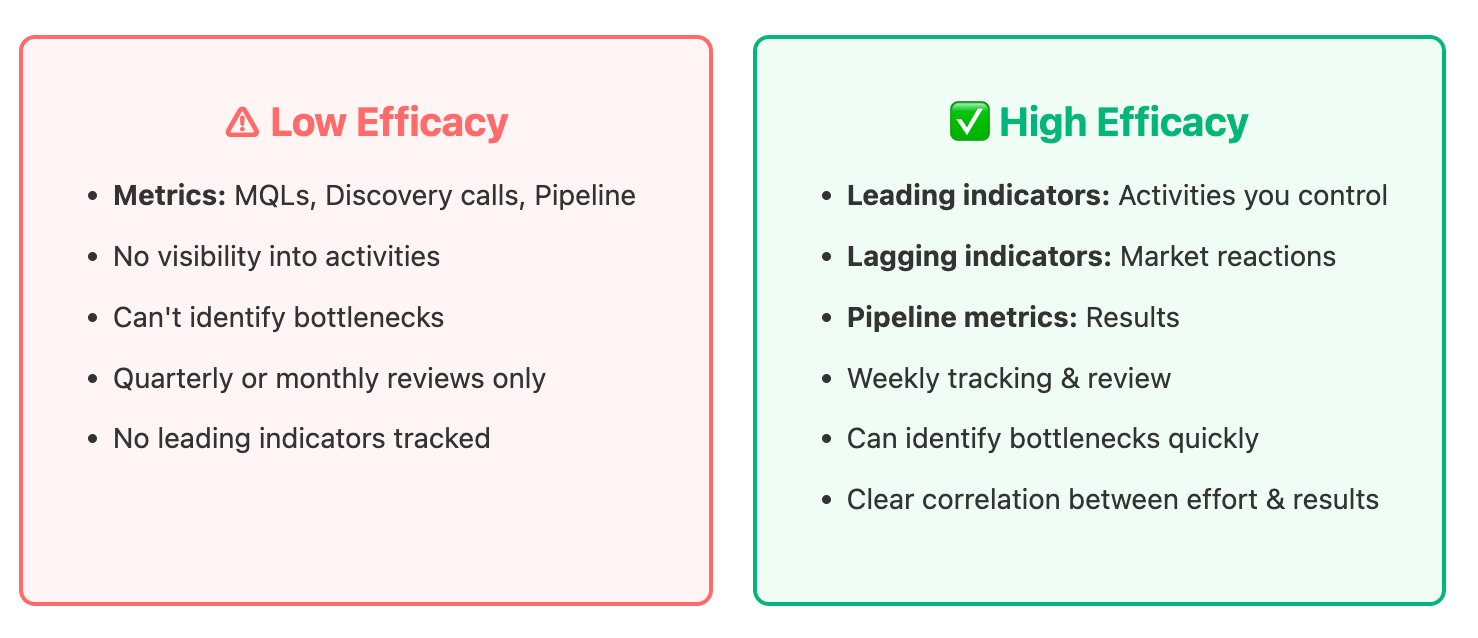
Metrics: No intermediate metrics. Only MQL and discovery calls, pipeline
Program reviews: Monthly/quarterly.
Discovery calls, pipeline created and revenue are the ultimate metrics we focus on, but they don’t tell you the whole story about ABM performance if we have long sales cycles. Especially if you’re just starting with program.
If you’re only tracking discovery calls and pipeline, you can’t diagnose problems and see what can be improved. You can only say “it’s working / not working” based on the # of discovery calls.
But if you see that:
Instead of 15 only 5 accounts were fully researched
Instead of 5 buying committees mapped, there were 2-3 buyers mapped
Instead of 50 event invites, only 15 were sent
Instead of 5 personalized pieces of content only one was created
You can see the real bottleneck: insufficient execution, not that “ABM is not working”.
The problem though is that because the marketing and sales team execute ABM in silos, the performance is usually reviewed either during the board or QBR. This is where the blaming and fingerpointing usually starts, and it’s too late to pivot.
To prevent this
High Efficacy Indicators
Metrics: leading indicators, lagging indicators, pipeline metrics
Leading Indicators (activities you control):
of content hubs/personalized offers created
of accounts researched and engaged
of non-sales touchpoints
of meaningful comments or value-added messages
of personalized connection requests
of new accounts fully researched
Lagging Indicators (outcomes):
Engaged accounts
Account penetration (# of engaged buyers per account)
Positive replies to outreach
Webinar/event sign-ups
Content collaboration inputs
Pipeline Metrics:
Discovery calls booked
Pipeline generated
Account-to-pipeline ratio
Learn more here: https://fullfunnel.substack.com/p/how-to-measure-abm-w-report-templates
Program reviews: Weekly by ABM team.
Learn more here: https://fullfunnel.substack.com/p/how-to-run-marketing-and-sales-alignment
Action Items to Fix
Step 1: Define core leading and lagging indicators with sales
Select 3-5 leading indicators
Select 3-5 lagging indicators
Define 1-3 pipeline metrics
Get joint agreement on what matters
Step 2: Set up weekly targets
Create simple tracking dashboard (start with spreadsheet), don’t build it in your CRM immediately
Set realistic weekly goals for every leading indicator. Make sure the targets are aligned with team capacity
Step 3: Install weekly planning and review meetings
Retrospective (what worked/didn’t work)
Leading and lagging indicators review
Identify bottlenecks and fix in real-time
Account insights and engagement review
Account planning for priority accounts
Pipeline update (add/remove accounts)
5. Playbook Orchestration
Current State Assessment
Planning Approach
Are playbooks planned upfront or they are dynamic?
Are marketing and sales planning together or in silos?
Compounding playbooks
Are activities connected (building on each other) or are one-off?
Account Development
How are accounts moved through stages?
Is it based on MQL handoffs or joint development?
Low Efficacy Indicators ⚠️
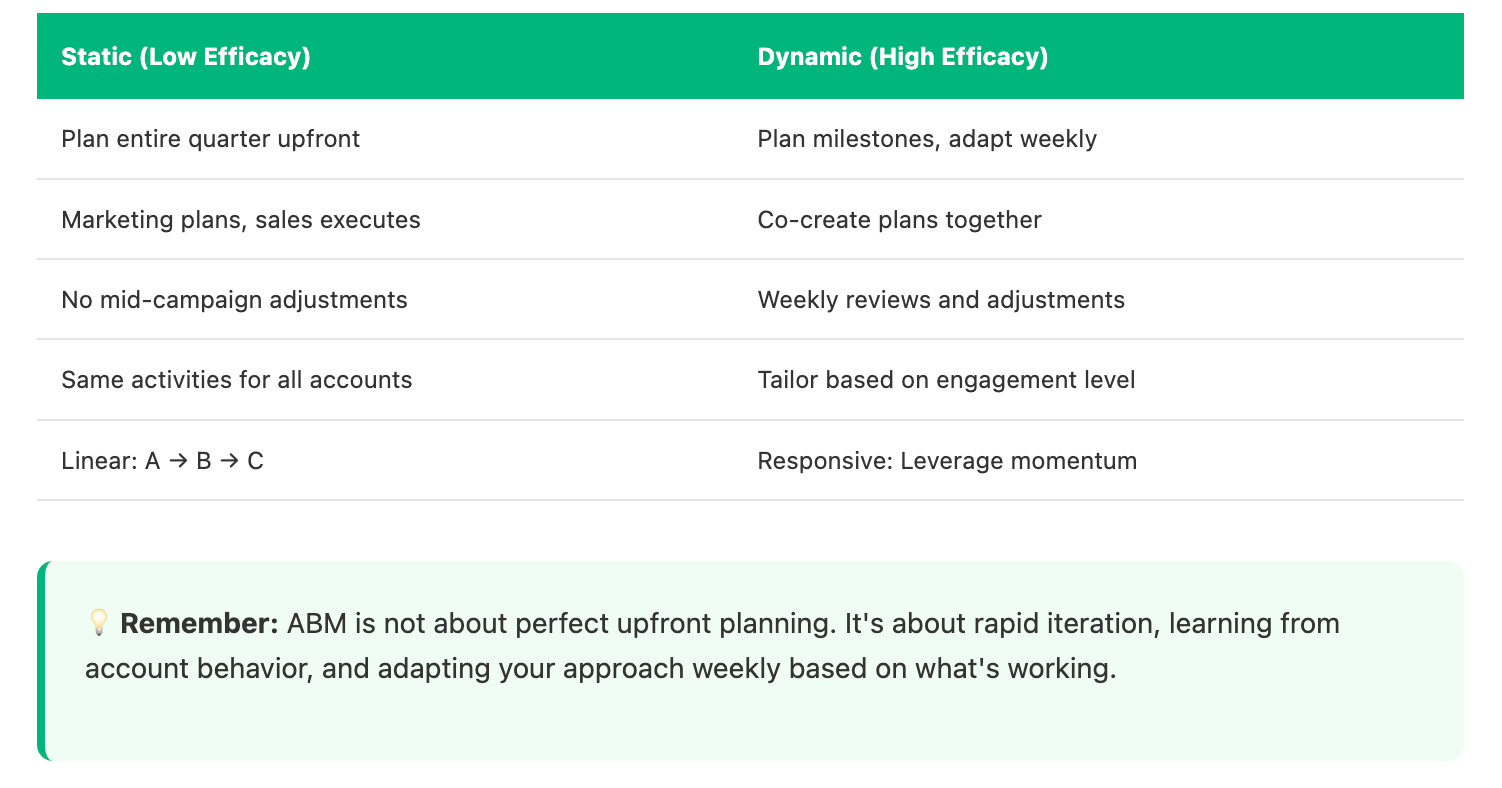
Orchestration: Static playbooks executed in silos
Planning: Pre-planned linear campaigns with the rigid timelines
Account development: Signal/MQL transfer from marketing to sales + sales pitching
The biggest mistake we see with ABM is developing the static linear playbooks that should be executed according to the rigid deadlines:
Week 1: produce an article that we’ll send as PDF to target accounts
Week 2: email PDF to everybody as “nurturing” and run ads
Week 3: email everybody saying “Why you’d consider YOUR PRODUCT”
Week 4: email everybody with a case study
Week 5: Ask sales to call everybody who has clicked the link or downloaded PDF
I’m generalizing but this is how the ABM playbooks are often orchestrated. The “nurturing” in nutshell is an attempt to attract attention with low-quality conten nobody cares about. Like assuming there is a timeline through which we can creating awareness and motivate buyers to buy.
One thing we all need to keep in mind - this is not how our B2B buyers buy.
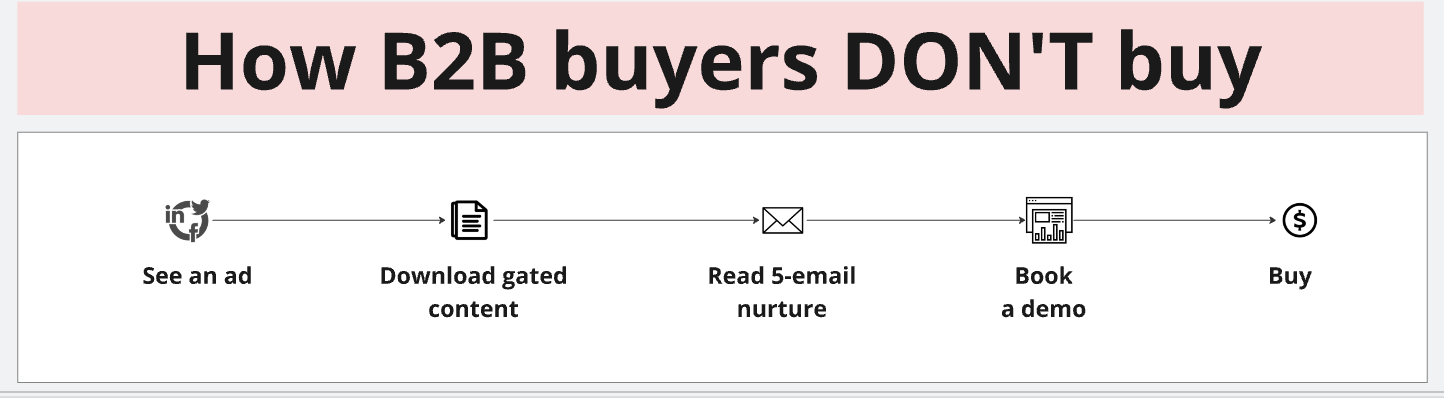
If we want to holistically influence the buyer journey, our program should be dynamic and cross-functional. Check the detailed guide here: https://fullfunnel.substack.com/p/aligning-abm-with-buyer-journey
This problem often occurs because the playbooks were created in silos, the responsibilities were not defined and agreed on, and the team’s bandwidth wasn’t aligned with the number of accounts added to the program.
But when everybody evidently sees that they can’t execute meaningful engagement, everybody moves to the convenient strategy while calling it “ABM”.
High Efficacy Indicators ✅
Orchestration: Cross-functional playbook coordination
Planning: Weekly planning and review meetings
Account development: Playbooks built on top of each other, dynamic and responsive to account behavior and signals. Lean approach - adapt week to week based on needs
Action Items to Fix
Step 1: Define team capacity and responsibilities
Who is part of the ABM program?
What is realistic time commitment per person?
Calculate: How many accounts can team handle?
Formula: Based on # of salespeople × hours available ÷ buyers per account
Step 2: Build a quarterly program calendar
Map out major initiatives (webinars, events, content releases)
Connect playbooks and build on each other, avoid static, disconnected campaigns
Step 3: Plan weekly success metrics for each playbook
For each activity/playbook, define:
What # of accounts engaging = success?
What specific outcomes = success?
6. Conversion Benchmarks
Current State Assessment
We love tracking account-to-pipeline ratio: how many accounts from your Active Focus and Future Pipeline lists became sales opportunities. This gives us a good benchmark to refine ABM programs.
Benchmark Ranges
Low Efficacy: <1% account-to-pipeline ratio
High Efficacy: 5-15% account-to-pipeline ratio (out of 100 accounts, 5-15 become sales opportunities).
Action Items
Calculate your current account-to-pipeline ratio
Accounts in the active focus and future pipeline lists (last quarter): _______
Pipeline opportunities created: _______
Conversion rate: _______%
Diagnose low conversion
If <1%: Review account selection and playbooks
If 1-5%: Review engagement strategy
If >5%: Optimize and scale what’s working
Set improvement targets
Current ratio: _______%
90-day target: _______%
Actions to bridge the gap: ________________
ABM Audit Scorecard
I promised in the beginning to share how to use the ABM audit scorecard. The first step you need to take is to rate your program on each component we covered in the article (1-5 scale):
1 = Not in place / Low efficacy
5 = Fully optimized / High efficacy
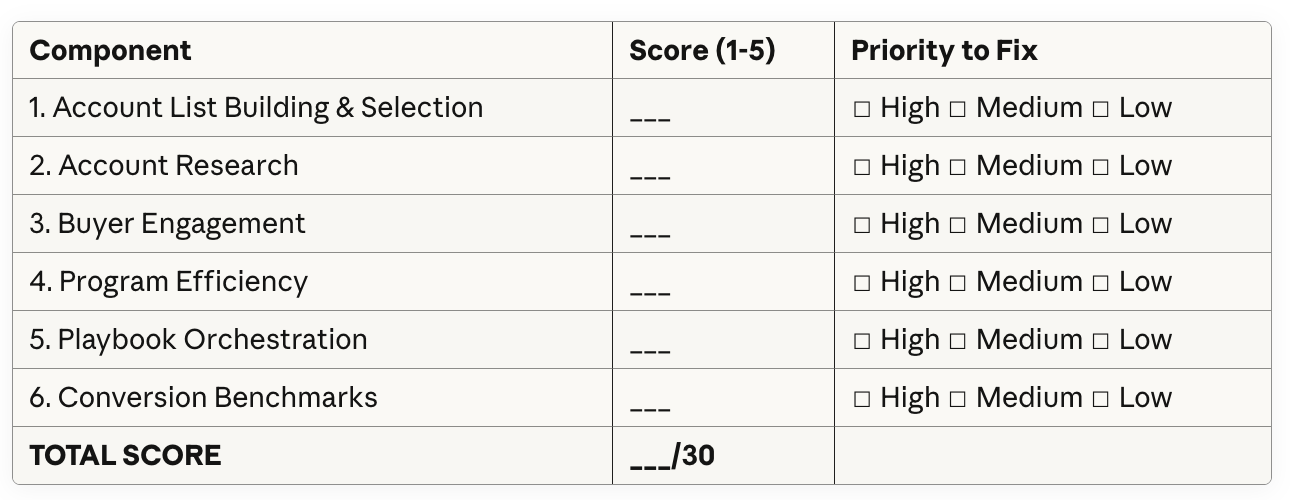
Score Interpretation
25-30: High-performing ABM program - focus on scaling
18-24: Good foundation - scale what’s working, fix gaps
12-17: Significant gaps - pause your program and build foundations
6-11: Low efficacy - shut down your program and rebuild it from scratch
For detailed implementation guidance, templates, and video walkthroughs of each component, access the Full-Funnel ABM Course at Full-Funnel Academy.
TLDR;
Most ABM programs fail because teams skip the foundation while chasing tactics:
1. Account selection: Prioritize qualified accounts by awareness level, relationship strength, and product need evidence — not sales wish lists
2. Account research: Create standardized processes that capture insights to plan engagement, not just personalize first lines
3. Buyer engagement: Manual relationship building supported by ads, not automated sequences at scale
4. Program measurement: Track leading indicators (activities you control) and lagging indicators (market response) weekly, not just pipeline monthly
5. Playbook orchestration: Build compound engagement where each touchpoint amplifies the next, not siloed parallel programs
6. Conversion benchmarks: Target 5-15% account-to-pipeline conversion as your north star metric
Stop treating ABM like a more targeted lead generation tactic.
Start treating it like what it actually is: a cross-functional motion to build relationships with strategic accounts before they’re actively shopping.
Watch Full-Funnel Live - Audit ABM.
*If you want to attend the next live episode, sign up here to receive an invite. Usually, we host them every Wednesday at 3:30 pm CET (Central Europe) - 09:30 am ET (Eastern Time).
In this episode of Full-Funnel Live, Vlad and Andrei provide a definitive guide to ABM evaluation. They’ll equip you with the frameworks and metrics you need to diagnose your program’s health, identify hidden weaknesses, and demonstrate clear, tangible value to your leadership.
💡 Tune in to learn:
How to evaluate if you’re running ABM program according to best practices
How to evaluate gaps in the ABM program that lead to poor performance
Evaluating ABM efficiency with leading and lagging indicators, and pipeline metrics