
🕵🏻♂️ The Full-Funnel OS
The key pillars of developing marketing operational system (OS)


Today we’ll cover:
Why “in the box” programs fail, and nobody can explain why
The five pillars of a marketing operational system
A full breakdown of the Full-Funnel ABM OS
Essential apps for B2B marketers

We wrote multiple times about “account blindness” and the problems with evaporating marketing influence on revenue in CRMs. Our challenge? The insights are scattered across multiple platforms, so we neither see the full account picture, nor can show the whole buyer journey with all marketing and sales touchpoints.
CFOs and leadership see only the last conversion/touchpoint, and approve the budget only for the programs that generated it. Ignoring everything that has happened before.
HubSpot (probably, a default CRM for marketing teams) just dropped its ‘2026 Essential Apps for Marketers’: It is a curated collection of 14 apps recommended by HubSpot that close that context gap inside your CRM and help you to show marketing impact on revenue.
Check it here: https://hubs.la/Q04jPbkR0
Have you ever wondered why one program worked in one vertical, segment, or market, then failed with another segment, market, or team?
Same assets. Same playbook. Same message. But completely different results.
We try to guess that, maybe, it’s a copy, or targeting, or the skillset of another team. But the keyword here is “guess”.
Quite often, we can’t replicate success because we don’t have the visibility of how well the program was actually executed. We only see the lack of immediate results. The teams, instead of diagnosing why the program doesn’t perform, usually start randomly changing things (message, targeting, etc), or revert to what historically worked for them (or what’s easier to do).
But the core reason why it’s hard to replicate a successful program:
There is no operational system and methodology behind it.
Some marketers will argue: “But we have created an ‘in the box’ program”. But ‘in the box’ is not an operational system. It’s just a vault of assets that other teams consider as “optional” to use.
Here is why it fails.
Why “in the box” programs fail
Let’s be honest, what is an “in the box” program?
The standard “in the box” program is a document (or portal) created by the team that ran a successful program. It includes:
modular content
a vault of scripts
AI prompts and skills
creative assets
content assets for sales
The idea behind the “in the box” program is that the other teams can take the assets that worked and replicate the success. But when it fails, there is no understanding why. The only two options are:
Blaming the team who tried to replicate the success or blaming the program.
But look at “in the box” from the perspective of another team. What do they actually see? A bunch of different content assets.
They can’t connect the dots between these assets and the goals they’re supposed to hit. So they do the natural thing: they cherry-pick the specific tactics they think might work and build their own playbooks. You end up with every team creating its own Frankenstein of your methodology.
When this happens, you can’t really evaluate whether the program worked or no. Why? Because the program that worked once for you was never fully implemented by other teams.
I’ve witnessed this earlier across three different teams inside one company that wanted to build an ABM program.
One team developed an exceptional cross-functional collaboration planning together the program, account engagement, content, and events for strategic accounts. Both marketing and sales were implementing the same playbooks and reviewed the performance every week.
In another team, the sales reps were trained on the account engagement methodology, but marketing wasn’t heavily involved in execution. They supported sales with modular content, signals, and broad always-on programs.
The third team started automating almost everything with AI before nailing down the core processes. They focused too much on the short term (”how do we book a meeting”) instead of the long term (”how do we create a pipeline”).
Each of the teams were running ABM, but in a completely different way. With different commitment and involvement.
The result: every team created its own version of full-funnel ABM. There was no way to compare the performance, because every setup and every time commitment was different.
There is another problem with “in the box program”.
It comes without defined:
Responsibilities
Time commitment
Measurement of how to evaluate whether the responsibilities were executed properly
What happens next usually is:
marketing and sales set the goals
define the target accounts
plan some activities,
Then, during the meetings, marketing usually asks sales about the progress. The sales rep says “I’m working on it,” and that is it. You don’t really know what’s happening.
Is the rep creating a sufficient flow of touchpoints with the target buyers? Are they trying to engage with the buyers, or just pitch them? How much time are they actually spending on engagement? And on the marketing side, is the rep getting enough support and enablement?
If you are a CMO or CRO, you want to know the answers to these questions backed by data, not by gut feeling or feedback “we do a lot”.
Otherwise, when the program fails, all you see is “we didn’t create enough pipeline.” You can’t evaluate why, because there are no leading KPIs and regular tracking. And you can’t confidently tell where the problem is: the quality of the messaging, the engagement, the playbook itself, or the methodology.
All of this comes from one reason. There is no operational system or methodology in place.
WORK WITH US
Need help with developing a scalable ABM OS? Book a free strategy session: https://fullfunnel.io/consulting/
Want to learn ABM and implement it yourself? Join our academy: https://fullfunnel.io/academy/ or buy our book: https://fullfunnel.io/full-funnel-marketing-book/
Want to get your product in front of B2B marketing leaders (we have 98k followers combined on LinkedIn + 27k subscribers on Substack)? See the formats and book a call here: https://roiplan.replit.app/
The five pillars of a marketing operational system
If I zoom out and look at marketing operational systems in general, regardless of the program, there are five core pillars.
1. Planning
Planning includes the rhythm (e.g. quarterly - weekly - daily) and the planning session structure: what the team works on, when, and how. This is where the teams do the goal decomposition into milestones, leading and lagging indicators, and concrete agreements with sales: responsibilities, commitment, measurement.
2. Playbooks and execution guidance
This is a document that tells the team what to do, why, how, and in what order. This is where best practices, scripts, examples, and quality benchmarks live, so “good” means the same thing for every team, vertical, or market.
3. Reports
The dashboards and reports that measure:
Account velocity or account development progress
Leading and lagging indicators
Pipeline and revenue created
These dashboards must be updated weekly, so you can control the execution and intervene when it is not too late.
4. Implementation control and coaching
To replicate the successful programs, you need to create an internal function (we call it center of excellence) that:
owns the quality standards
onboards other teams
controls execution
Troubleshoots
runs audits and retrospectives.
This function ensures that everybody runs the same methodology without cherry-picking tactics and creating their own versions of the program.
5. Visibility
A methodology must include visibility. It answers the one question every leadership team asks: how do you know if we’re doing the right things and if it’s working?
We break down visibility into three pillars: quantitative, qualitative, and operational visibility.
In the next section I’ll break down the Full-Funnel ABM OS as an example of how these five pillars work together.
BECOME A FULL-FUNNEL B2B MARKETER

Full-Funnel Academy is a comprehensive B2B marketing training and Slack community for B2B marketers who care about revenue and want to move the needle.
Academy includes:
All our B2B marketing courses including ABM playbook, Demand Gen Playbook, LinkedIn Allbound marketing playbook and 11 more courses that aren’t available publicly + all upcoming courses.
Private Slack community to answer all your questions
Personalized learning plan. If you are not sure what skills you’d develop in the first place and how to get maximum from the program, we can create a personalized learning plan accordingly to the time you can dedicate to education.
Behind-the-scenes sessions. See what’s working and what doesn’t work and why on the “behind the scenes” sessions where we review the campaigns we are running for our clients and us.
Learn more and join the academy here.
The Full-Funnel ABM OS as an example
To share a practical example, I want to review our full-funnel ABM methodology. Here is how we build each pillar inside a full-funnel ABM OS.
1. Planning
Planning has four cadences: quarterly, weekly, daily, and a retrospective.
1.1. Quarter planning
The quarter planning starts with goals, broken down into milestones, leading and lagging indicators, and agreements with sales:
their involvement,
their responsibilities,
and the metrics they own.
Most teams do this planning in silos. Marketing says “here is our program, and here is what we expect you to help with.” Sales says “here is our target list, and we need a new deck.”
Sales never understand how the program leads to revenue, and marketing ends up taking design and content orders from sales.
Quarter planning is a joint exercise for marketing and sales, and should involve VP of Marketing and VP of Sales. The data we use for planning and goal setting:
Sales pipeline velocity (win rates, number of opportunities, sales cycle length, ACV across markets, verticals, and clusters),
Revenue programs we want to focus on (new market entry, net new pipeline, expansion, etc)
Account qualification and prioritization criteria to define accounts that deserve personalized attention from marketing and sales
Learn more: Marketing and sales planning and How to run marketing and sales alignment and sync meetings
From there, we plan the ABM program: target accounts, key activities, and the timeline. Here are two fundamental rules we use.
Rule 1: build the program plan using the 6A framework
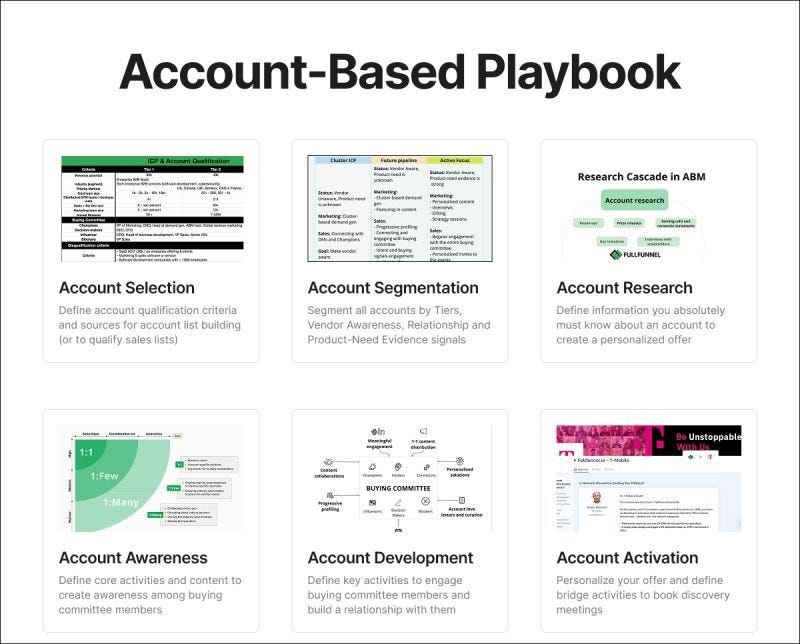
ABM was never about the stack or the budget. The success of ABM lies in strong GTM fundamentals, cross-functional alignment, and alignment with the enterprise buyer journey.
We use 6A framework to plan the whole program:
Account qualification: the criteria and signals that make a company a good or bad fit, plus the buying committee structure.
Account segmentation and prioritization: splitting accounts into Cluster ICP, Future Pipeline, and Active Focus by vendor awareness and product-need evidence.
Account research: strategic initiatives, jobs-to-be-done, KPIs, and challenges of the buyers),
Account awareness: how we’ll create awareness and attract attention of the buying committee groups
Account development: how we’ll engage, build the relationship and nurture the buying committee groups
Account activation: what activities we’ll run to book discovery calls and create sales opportunities
Learn more: ABM strategy 3.0
Rule 2: every playbook is optimized for the long sales cycle, and the playbooks compound on each other
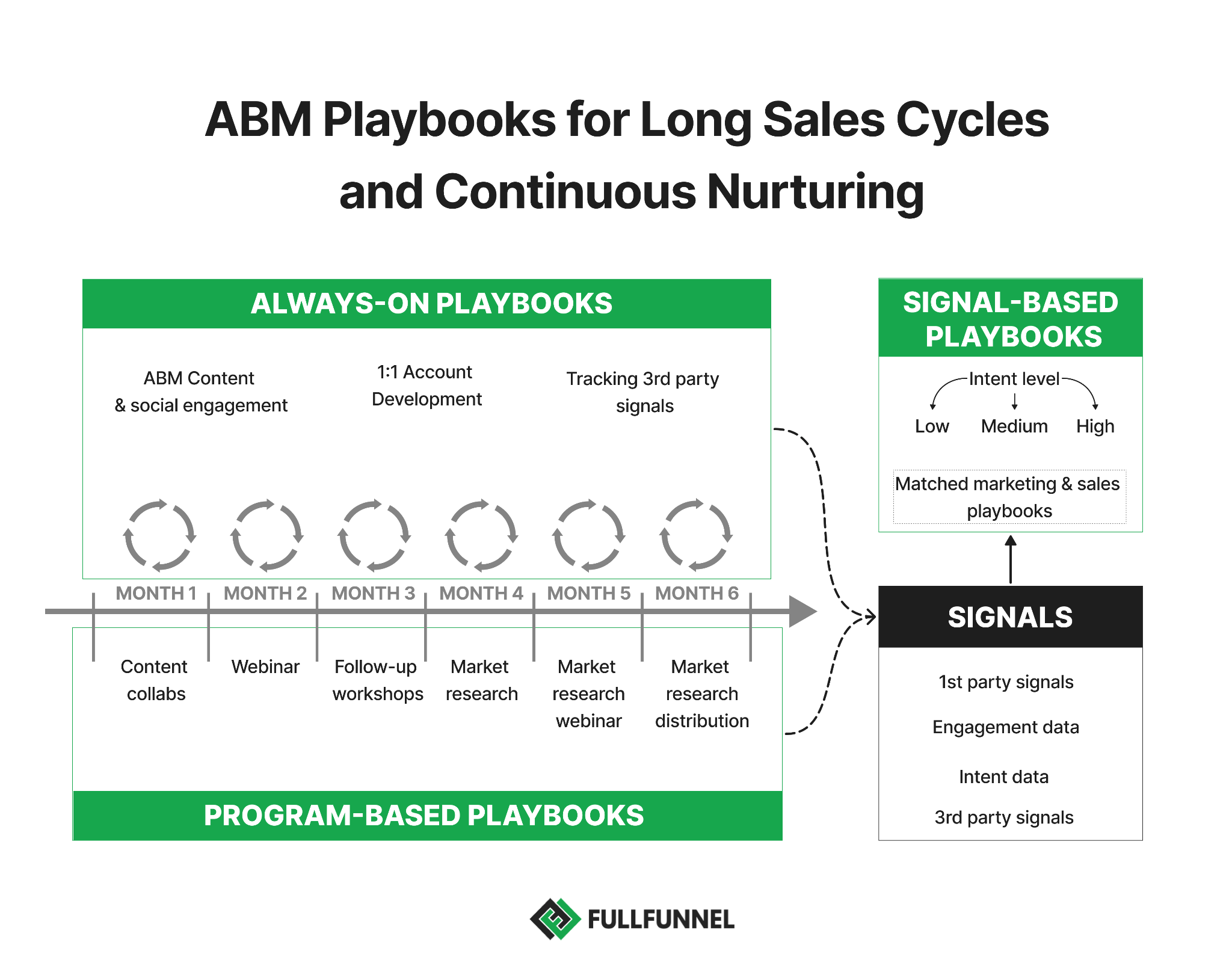
Here is the fundamental mismatch in enterprise B2B marketing: marketing and sales teams engage accounts with three-week sales cadences and marketing campaigns while the enterprise sales cycle is 12-18 months. If the account doesn’t reply or book a call, the team moves on.
At the same time, multiple research studies report that the deals above $100k require 400+ touchpoints and 5300+ impressions.
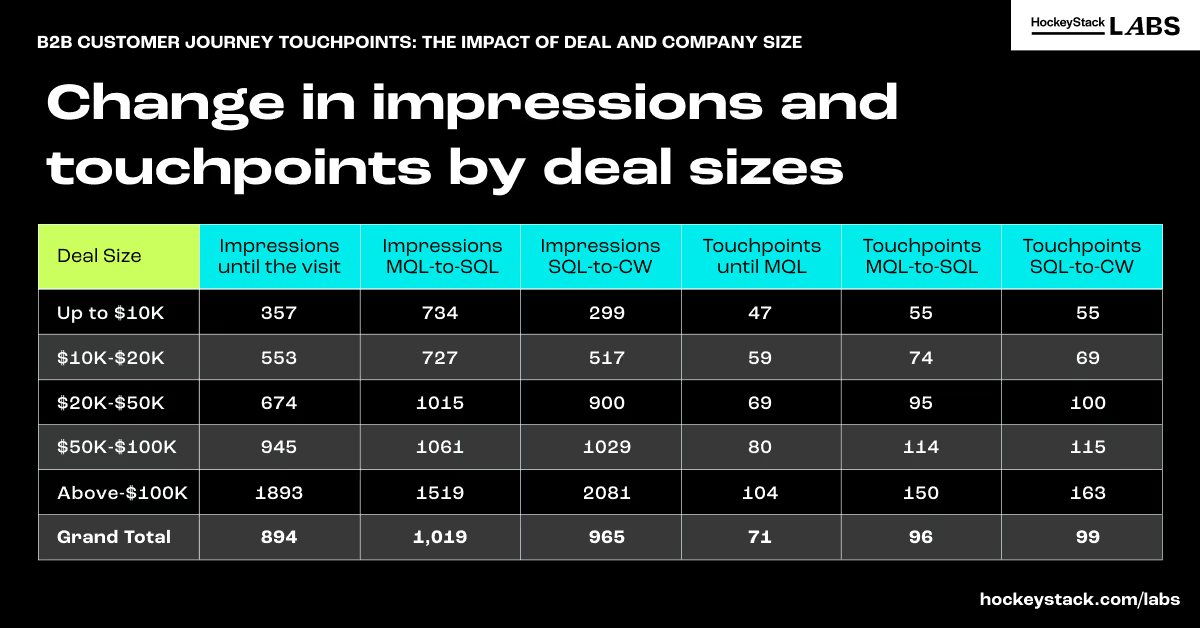
TLDR; If your playbook isn’t aligned with this reality and is aligned with your sales cycle length, it won’t work.
The enterprise playbook needs:
In-depth research and account mapping
Account narrative and POV (point of view)
Constant engagement with five or more buying committee members across the entire cycle
Personalized activities and content for Active Focus accounts
Timely follow-ups based on first-party and third-party signals.
You run time-based and signal-based playbooks in parallel, so each one builds on the last instead of starting from zero every time.
Learn more: How to create playbooks for long sales cycles and multiple buyers
The last step in the quarter plan is account prioritization.
I had a great call last week with an enterprise Account Executive. She asked:
I love the methodology, but how can I scale it across my SDRs? They won’t be able to engage all accounts in a personalized way.
She is absolutely right.
That’s why we define together the criteria to identify Active Focus accounts: the accounts that are aware of you, you have a good relationship, and have enough insights to create a fully personalized offer for them.
Usually, you won’t have more than 10 accounts that fit these criteria for one sales rep. It’s enough for a quarter development. Sales and marketing move these accounts to fully personalized cadences and engage the buying committee every week.
All other accounts stay in a lighter sales engagement cadences until they are not prioritized.
1.2. Weekly planning
Every week we work with the ABM team on:
account plans
program and playbooks execution
Leading and lagging indicators review
a signals review
a review of wins and bottlenecks
and the to-do planning for the next week.
We also do a quick retrospective:
what worked and what didn’t
what can be done better and implemented immediately
what got in the way, and how we can fix it
Some teams tell us that they host these sync meetings, but they are often not very productive. One of the reasons I have personally observed why this happens is the next one.
A CMO or an ABM lead invites to the meeting multiple people, most of whom are not actually involved in the ABM program. The ABM team ends up debating things that weren’t on the agenda with no actionable planning at the end.
To make weekly planning sessions productive, keep these meetings to four people maximum: marketing, sales, content, product. Invite only the relevant people.
1.3. Daily standups
Daily standups are short and focused meetings to discuss what is getting done today and if there are any bottlenecks. They are essential when you launch a new program. They help prevent awkward situations at weekly meetings like, “I haven’t done this because I was distracted by that...”.
1.4. Quarter or monthly retrospective
A 60-minute meeting to review the program progress:
What could be done better
what’s working well
the new ideas worth testing.
Learn more: How to run marketing and sales alignment and sync meetings
2. Playbooks and execution guidance
The real reason most companies can’t make ABM work and later scale it is the lack of strong documentation and orchestration. The scaling usually happens via “in the box programs” I’ve described earlier: “here is our stack, here are the ads and the creatives, here is the messaging, go and replicate it.”
The problem is that there’s no proven, detailed process the team can take to replicate the success.
The ABM playbooks we develop have four parts.
2.1. The planning process: who is involved and who owns it
There’s a false assumption that ABM is fully owned by marketing and can be run programmatically as one-to-many.
While marketing owns program orchestration, sales own critical execution areas like buying committee engagement.
Without a dedicated sales rep, all you will be able to do is to:
Run a generic AI “research”
Set up LinkedIn ads to a broad sales list
Write with AI or Clay outreach emails based on the AI research
With an additional budget, send gifts via Postal/Reachdesk to target buyers
Pretty much that’s it. But, as you guess, it’s absolutely not enough to engage strategic accounts.
With a dedicated rep, you can actually run nurturing and engagement playbooks to create awareness and engage strategic buyers. It also helps sales reps to become a known “trusted advisor”, not yet another sales rep begging for a meeting.
The goal is to define sales responsibilities in every playbook, realistic time commitment, and KPIs to track the progress.
Learn more what sales own in ABM here: Who owns ABM
2.2. Step-by-step execution
The next step is to create a clear guidance on what we should do as a team every single week. Not “engage this account”, but:
“This week for account X we’ll prepare an account love letter. You’ll publish it on your profile on Wed, and distribute it to all buying committee members on LinkedIn. You need to identify them and send connection requests on Mon. On Thursday, we’ll boost it with the thought leadership ads. On Friday, for those who won’t reply on LinkedIn, send an email follow-up”.
Now it becomes a clear actionable plan.
For every activity that you include into your program (field events, webinars, direct mails, whatever), you need to have this detailed plan.
Learn more: Operationalizing ABM
2.3. Scripts, examples, and quality benchmarks
The goal of the documentation is to create internal quality benchmarks and a clear definition of what “good” looks like for every process: account research, content, emails, messaging, copy, etc. The output shouldn’t depend on who is doing the work.
One company we worked with learned this the hard way.
One of their ABM programs worked well because they assigned a committed content writer to work directly with sales. They worked together to create the content for different accounts. A new ABM lead declared that it is “not scalable” and replaced the content writer with AI prompts and modular content for reps to self-serve.
Unfortunately, BDRs are not content strategists. Somebody has to coordinate content with subject-matter experts, make the judgment calls on what to create, and review the quality. Because account-based content is what makes a rep look like an industry expert instead of just another seller. It helps sales to ignite the conversations with the target buyers.
As you guess, the performance of the content immediately went down until the sales reps stopped using the content at all.
Learn more: Operationalizing ABM
2.4. AI enablement: setup, skills, MCPs
Don’t get me wrong. Despite the fact that I often post sarcastic posts about AI, I don’t mean you’d use it. You should, but at the right point and with the right setup.
We’ve seen multiple teams with a temptation is to automate everything from day one of ABM program execution:
connection requests
email outreach
content production
account research
account narrative and POV
It looks productive. But it prevents both marketing and sales from learning the process and seeing what content, messaging and engagement actually resonates before it is automated. You never build a real quality benchmark, because you’re treating the AI output as the benchmark.
To make AI working for you, you need to create and prove the process manually first. Document it, and then rebuild it with AI. Then, regularly refine it.
If you automate before you’ve nailed the process, you’ll never know the reason why it’s not working.
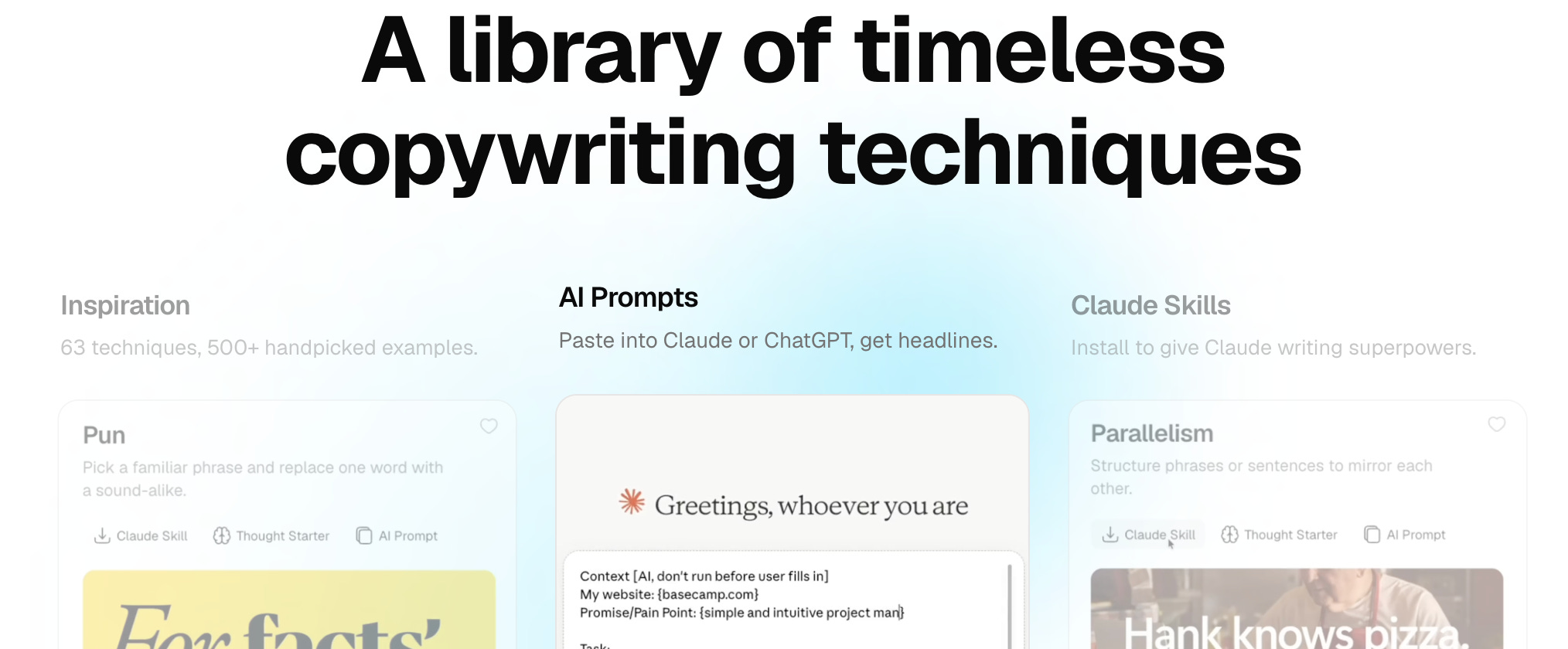
If you write copy, I highly recommend CopyTemplates by Shlomo Genchin who was on our podcast multiple times. It includes 63 techniques, 500+ examples, 70+ AI prompts & Claude skills. $97.
3. Reports
If you have a long sales cycle, you can’t expect immediate pipeline and revenue coming from ABM. The classic SaaS metrics (CAC, LTV:CAC, payback period) will tell you the program is underperforming only when it’s too late, after you’ve already burned the budget. How can you know if the program works?
We use two types of reports to track leading and intermediate lagging indicators.
3.1. A progress dashboard with weekly measurement.
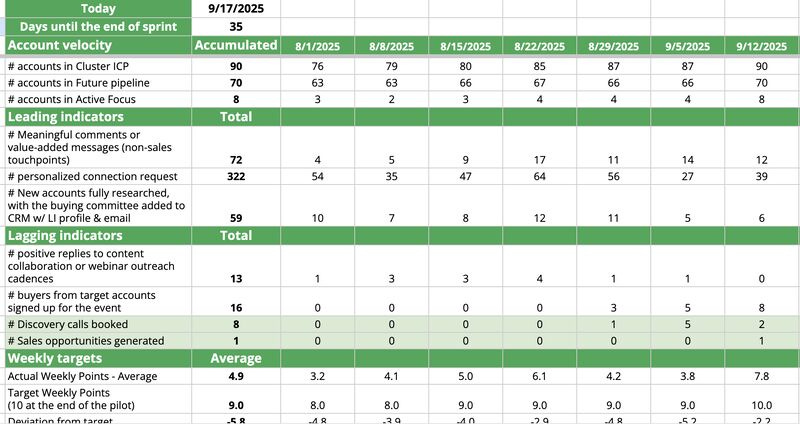
If your sales cycle is above twelve months, you need to measure account velocity, leading and lagging indicators, and pipeline created on a weekly basis, not at the end of the quarter. Here is a quick breakdown of these three pillars.
3.1.1. Account velocity
We show account progression moving prioritizes accounts from being unaware of us to working on deal creation.
90 accounts in Cluster ICP → Tier 1-2 accounts that fit ICP criteria with light engagement
70 accounts in Future Pipeline → Hit our engagement threshold, are researched and engaged by our sales team
8 accounts in Active Focus → Accounts with good relationship and known needs where sales and marketing works on deal creation via 1:1 account plans.
3.1.2. Leading indicators
Leading indicators represent our activities to create awareness, nurture, and engage the buying committee members.
322 personalized connection requests → Mapping and connecting with the buying committee, not focusing on decision-makers only
59 accounts fully researched → Necessary insights for further personalized engagement
72 meaningful touchpoints → Relationship-building and nurturing.
Translation for leadership:
“86% of enterprise B2B buyers prioritize known vendors before they enter the market. We want to ensure we get into consideration.”
3.1.3 Lagging indicators
We show actual pipeline and revenue attribution:
8 discovery calls booked → $1.6M in potential pipeline (assuming $200K ACV)
1 sales opportunity generated → (allbound or ABM-sourced if you will).
We got great feedback about this dashboard from multiple teams we’ve been working with. 3 core benefits they mentioned:
Connecting activity to pipeline stages: No need explaining why 500 MQLs generated zero revenue
Showing progression toward revenue – Leadership sees accounts moving through pipeline creation stages.
Providing leading indicators – Shows GTM team productivity and lays foundation for scale (e.g. what if we worked on this program full-time?)
It also allows CMOs to shift the narrative from: “Marketing generated 500 MQLs this month” to: “We moved 8 high-value accounts into active focus, representing $1.6M in qualified pipeline.”
Learn more: GTM efficiency for long sales cycles
3.2. Weekly pillars with leading and lagging indicators
This report replicates the same dashboard, but is for daily tracking. You then populate the accumulated results into a main dashboard. This report helps you to measure ROI of your efforts and honestly answer a question:
Do we put enough effort and create enough touchpoints with the target buyer to generate sales opportunities?
Learn more: ABM KPIs and reports
4. Implementation control and coaching
As I mentioned in the beginning, this function ensures that everybody runs the same methodology without cherry-picking tactics and creating their own versions of the program. Here are 4 pillars we implement.
4.1. Create a center of excellence (COE)
Scaling is not localizing and replicating, but adaptation of what works. This happens only when there is somebody who helps to adapt.
The center of excellence is the team that ran a successful pilot and is now in charge of internal scaling. This team not only owns the methodology, but also onboards and coaches other teams, helps with implementation and controls the execution.
Before touching any playbook or asset, the COE runs a brief GTM analysis with other teams to uncover what GTM challenge does this team actually face? Brand awareness (”nobody knows us in this market”)? Stalled pipeline (”deals aren’t moving”)? Competition (”we’re losing to a local player”)?
The answer becomes a pilot program goal. The team that is going to run the pilot sees now that the ABM program is aligned with their challenges.
Learn more: How to build a repeatable, regionally scalable full-funnel ABM motion
4.2. Onboarding and implementation sprints
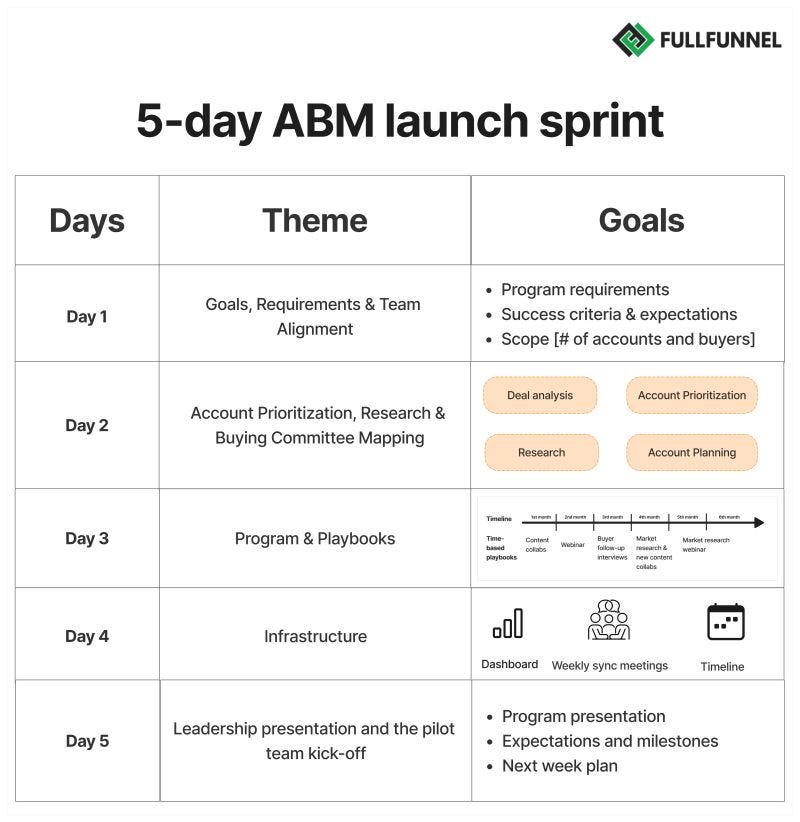
We looked at our best case studies and realized that the best ones were where we were able to finish the pilot program prep and onboarding quickly, and gone straight into execution. The programs that underperformed had long, stretched-out onboarding.
ABM program is a chain of decisions made by multiple people across teams: strategy, qualification criteria, account selection, research process, playbooks, reporting, operational rhythm.
But if you spread this decision-making process across five or six weeks, you create perfect conditions for failure. People forget the agreements, forget the logic behind the decisions, and lose track of their responsibilities. Then comes the rush that always leads to skipping essential steps because “I know how to do it.”
That’s why we shifted to building the full pilot in a five-day sprint. You lock the team and focus their attention on program onboarding, joint planning and test execution, so everybody knows the why, what, and how. The sprint ends up with a clear plan of actions for the next week, and scheduled sync meetings to monitor the execution.
Learn more: ABM sprints
4.3. Implementation control, regular coaching, and troubleshooting
The COE team meets other ABM leads once a week to go through program implementation. The goal is not to micromanage, but to prevent any issues with implementation before the program fails. Another goal is to make sure the team is putting in real effort, not just creating their own version and saying “we’re working on it.”
Whenever the COE identifies that the program is not implemented properly, they book calls with the team members and walk them through the processes. If these team members still sabotage the execution, COE troubleshoots the leadership.
4.4. Quarter audits and retrospectives
Regular audits of execution by COE prevent other teams from cherry-picking tactics, building their own version of ABM, and then complaining that it doesn’t work. There’s a real difference between doing ABM and doing ABM well. With a structured audit process COE can immediately see the gap and fix it.
Learn more: How to audit your ABM program
Order Full-Funnel B2B Marketing book

Stop chasing MQLs that don’t convert. Start building an enterprise pipeline that sales actually thanks you for: without massive budgets, organizational overhauls, or waiting for perfect conditions.
Built from 50+ enterprise ABM programs across companies from $10M to $1B+ ARR, this book gives you the systematic approach that helped dozens of B2B marketing leaders:
Fix the broken GTM playbook and drive millions of revenue from new programs developed and tested over a couple of quarters
Quickly provie impact of new marketing programs with 90-day pilots to earn runway for longer-term brand and demand programs
Create repeatable playbooks that work within the constraints most B2B CMOs face: long sales cycles, skeptical executives, misaligned incentives with sales, and quarterly pressure to hit pipeline targets
Get leadership buy-in for changing marketing playbooks without asking for additional budget or resources
Deploy AI to refine and accelerate proven playbooks, not just “do more with less”
Align marketing and sales around revenue and pipeline generation (not leads)to stop working in silos
Scale proven playbooks (what works) across the organization
Systematically move strategic accounts through the buyer journey:from unaware to sales opportunities
No matter where you are:
running on a ‘quarterly MQL hamster wheel’, unsuccessfully trying to optimize within impossible constraints,
dealing with frustrated sales teams,
fighting attribution battles with leadership,
or simply knowing your GTM playbook is broken but not being sure how to fix it
this book gives you the blueprint to transform your marketing function without internal revolution, starting from today.
5. Visibility
The last pillar helps to get an honest answer to the question: how do you know if we’re doing the right things, the right way, and if it’s working?
We break down visibility into three components.
5.1. Quantitative
This is the dashboard with account velocity, leading and lagging indicators, and weekly pillars report I’ve shared above. It helps you to see if you are putting enough effort into the program and what’s the ROI of your efforts.
5.2. Qualitative
Qualitative visibility is the market and sales feedback you need to collect and share, and the lagging indicators.
Whenever you engage with the target buyer and they share something like: “I liked your recent post, and shared it with my colleagues”, this is great qualitative feedback that proves a specific activity works.
When sales reps come and say: “I had a discovery call with a third strategic account, and they again mentioned they don’t understand what our product does”, it is another qualitative feedback that tells you what should be fixed.
When you run a webinar, you see three buyers from the same account signed up, and then you see a spike of account visits on your website, this is another qualitative feedback.
All these signals never show up in your CRM, but they actually show you if something works.
5.3. Operational
The last point is one that I almost never see across the teams that tried to implement ABM:
How well was the methodology actually implemented? Did the team qualify all the accounts according to the qualification criteria or just targeted a wish list? Did the team execute all the steps in the playbook, using the internal best practices, for every buyer, or did they skip some of the steps?
If you don’t have this in place, you’ll never be able to figure out why a specific program that worked initially failed later.
TLDR
Most attempts to scale successful marketing programs fail because there’s no operational system and methodology. The leadership only sees the lack of immediate results without visibility into how well the program was executed.
Teams try to fix this with an “in the box” program: best practices, modular content, scripts, prompts, and assets in one document, handed to other teams to replicate. When it fails, nobody can explain why.
An operational system enables the successful scaling. It has five pillars: planning, playbooks and execution guidance, reports, implementation control and coaching, and visibility: quantitative, qualitative, operational.
Visibility answers the most important question: how do you know if we’re doing the right things, and that it’s working?
For every part of the full-funnel OS, we’ve developed a methodology: how to create brand awareness, how to nurture strategic accounts, how to create account-based content strategy, etc.
I plan to write more in-depth guides on these topics. Let me know in the comments which one you’re interested in?
Drive pipeline THIS quarter with full-funnel ABM programs.
If any of these challenges sound familiar:
You are aligned in theory with sales but don’t do anything in practice aside from receiving wish lists from sales and sharing with them your marketing plan. In reality, you work in silos and miss the revenue targets and are being pressured by your executives.
You understand that your marketing and sales playbook is broken (mqls, gated content) but despite many attempts you don’t know how to fix it
Your outbound, paid ads and organic pipeline drastically decreased while CAC increased mostly because most of your market is problem unaware and not buying.
You lack brand awareness among target accounts and sales can’t get even a reply.
You clearly see that you’re already behind your revenue targets
We can help.
We’ll develop a custom full-funnel ABM strategy aligned with your resources, budget and stack and execute it together to drive results THIS quarter.
Watch Full-Funnel Live - How to create awareness among strategic accounts.
*If you want to attend the next live episode, sign up here to receive an invite. Usually, we host them every Wednesday at 3:30 pm CET (Central Europe) - 09:30 am ET (Eastern Time).
In this episode of Fullfunnel Live, we decided to invite Kerry Cunningham (leads research at 6sense) and Matt Heinz (Heinz Marketing) who ran a couple of research studies interviewing B2B CMOs about what works today to create brand awareness.
Tune in to learn:
How buyers’s experience with the sales reps influences the purchase decision
What works today to create awareness among strategic accounts
How to measure brand awareness among strategic accounts