
🕵🏻♂️ Contact-level ABM
How to personalize your engagement with the buying committee members that are on different buyer journey stages.


In today’s newsletter:
The rotten reality behind the “contact-based plays” narrative
How to personalize your engagement with the different buying committee members at scale and at 1:1 level
How to create a continuous nurturing through 18-month sales cycles
Lift pipeline conversion by up to 118% with Contact-Level ABM

Influ2 analyzed 2M targets and found that when teams run ABM at the contact level, pipeline conversion increases by up to 118% (among other things).
But the lift doesn’t come from sending more emails or targeting more accounts.
It comes from catching the first moments of real buyer interest and knowing exactly who’s behind it.
And that’s only possible with contact-level ABM.
Want to see the details?
The rotten reality behind the “contact-based plays” narrative
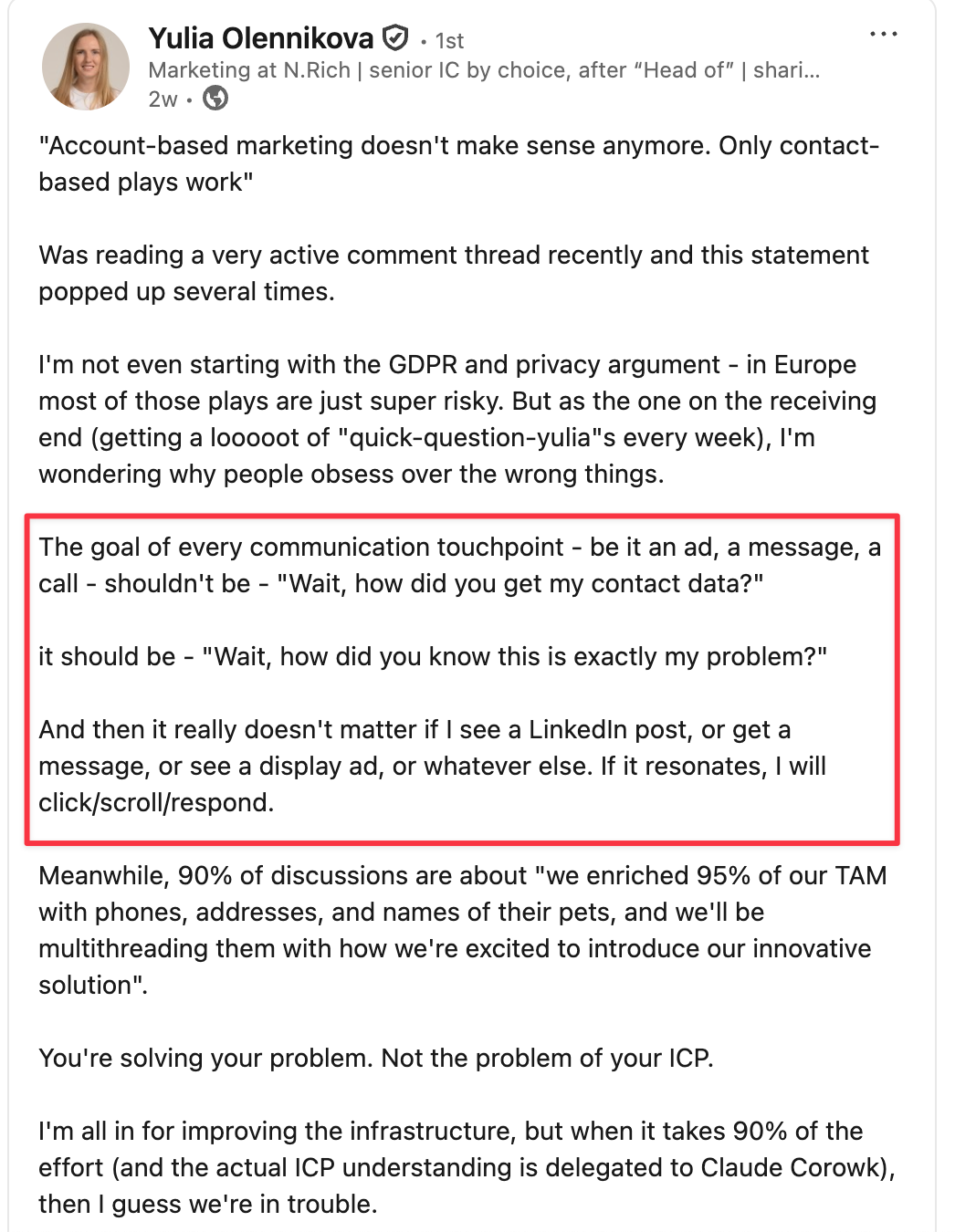
“Account-based marketing doesn’t make sense anymore. Only contact-based plays work”.
Yulia Olennikova, Sr. Marketing Manager at N.Rich, recently mentioned an active thread where people were sharing this statement. The idea behind just brings back the old-schooled lead gen now done at scale:
Scrape and enrich contacts
Ask AI to write a personalized outbound cadence
Order a Pina Colada and wait for the sales opps coming in
The real problem I see is that people who write these comments, probably, have never done a proper ABM. They don’t know that ABM happens both on account and contact level. If you don’t connect buyer’s priorities to account priorities, you simply would drive the wrong POV (point of view).
I know where this narrative is coming from:
it’s easier to justify the tech spent and agency or hiring a GTM engineer to “do ABM”
for marketing, it’s easier to take a defensive role saying “we are giving you an infrastructure” while trying to become “AI native”
it clicks with the leadership desire that “everything should be scalable”
This set up brings us back to old school lead gen everybody was mocking up on LinkedIn.
Yulia just hit the nail in the head (see the post below):
It solves your problem, not your buyer’s problem.
The goal of every touchpoint should be: “Wait, how did you know this is exactly my problem?“
Pre-order Full-Funnel B2B Marketing book before 5th May and get an implementation toolkit

Stop chasing MQLs that don’t convert. Start building an enterprise pipeline that sales actually thanks you for: without massive budgets, organizational overhauls, or waiting for perfect conditions.
Built from 50+ enterprise ABM programs across companies from $10M to $1B+ ARR, this book gives you the systematic approach that helped dozens of B2B marketing leaders:
Fix the broken GTM playbook and drive millions of revenue from new programs developed and tested over a couple of quarters
Quickly provie impact of new marketing programs with 90-day pilots to earn runway for longer-term brand and demand programs
Create repeatable playbooks that work within the constraints most B2B CMOs face: long sales cycles, skeptical executives, misaligned incentives with sales, and quarterly pressure to hit pipeline targets
Get leadership buy-in for changing marketing playbooks without asking for additional budget or resources
Deploy AI to refine and accelerate proven playbooks, not just “do more with less”
Align marketing and sales around revenue and pipeline generation (not leads)to stop working in silos
Scale proven playbooks (what works) across the organization
Systematically move strategic accounts through the buyer journey:from unaware to sales opportunities
No matter where you are:
running on a ‘quarterly MQL hamster wheel’, unsuccessfully trying to optimize within impossible constraints,
dealing with frustrated sales teams,
fighting attribution battles with leadership,
or simply knowing your GTM playbook is broken but not being sure how to fix it
this book gives you the blueprint to transform your marketing function without internal revolution, starting from today.
And if you want to do it at scale, this is only possible when you:
Pick up a specific use case (aka cluster targeting)
Define characteristics of accounts that have this use case ( account selection and qualification)
Define primary buyer persona
Do a cluster decomposition to create account-based content strategy that resonates on 1:many level
Define what accounts deserve full personalization and 1:1 engagement (account prioritization)
Then, you’ll be able to nurture at scale while fully customizing your engagement with the accounts that are likely to be converted into sales opportunities this quarter.
I’ll skip these stages (we dive deep in our Full-Funnel ABM course).
BECOME A FULL-FUNNEL B2B MARKETER

Full-Funnel Academy is a comprehensive B2B marketing training and Slack community for B2B marketers who care about revenue and want to move the needle.
Academy includes:
All our B2B marketing courses including ABM playbook, Demand Gen Playbook, LinkedIn Allbound marketing playbook and 11 more courses that aren’t available publicly + all upcoming courses.
Private Slack community to answer all your questions
Personalized learning plan. If you are not sure what skills you’d develop in the first place and how to get maximum from the program, we can create a personalized learning plan accordingly to the time you can dedicate to education.
Behind-the-scenes sessions. See what’s working and what doesn’t work and why on the “behind the scenes” sessions where we review the campaigns we are running for our clients and us.
Learn more and join the academy here.
How to personalize your engagement with the different buying committee members at scale and at 1:1 level
Step 1: Select your cluster
A cluster is a group of accounts that share the same strategic challenge or belong to the same use case. They might be from different industries, but have the same business problem.
Cluster targeting helps you to create relevant messaging and content for this group of accounts at scale aka (citing Yulia): “Wait, how did you know this is exactly my problem?”).
To make it practical, let’s imagine that we are working for a company selling data strategy and custom data solutions.
Cluster: Inaccurate revenue forecasting and customer churn predictions.
Verticals: fintech, banking.
Account qualification:
Raised above $10 mln in the last 9 months. Forecasting accuracy becomes a board-level concern because of the growth pressure.
Run on Salesforce.
Hiring Salesforce administrators/architects aka “throw headcount at the data problem”
The last point helps us to understand the current journey of the account. When a company is expanding its Salesforce admin team, it’s already aware that the current setup is creating data problems. But they just haven’t yet accepted that the platform is the constraint.
Instead of talking about broad data problems, we pick up a relevant use case and start talking about it. It helps to prepare a narrative about Salesforce limitations (data silos, no real-time data, fragile code) and possible solutions (aka tracking a “downward trend” in login frequency or feature usage over weeks).
Here you develop your nurturing layer at 1:many level.
Step 2: Research the account and map the buying committee
Skipping the rest of the foundational steps, let’s move to a concrete example for a specific account.
Here’s what we do for every account before engaging with them.
1. Account research
We start with what strategic projects the account is currently funding that are relevant to our solution. Where are they actually investing money right now?
Let’s say we picked up an account that 100% matches our cluster and qualification criteria. Our goal is to identify where they are investing, what they priporitize, and what metric we want to influence on the account level.
Here are the insights that we’ve collected.
Closed a $14M Series B nine months ago
Running Salesforce as their core operational platform
Two senior Salesforce admins working with contractors to build custom reports and dashboards
Just posted two new Salesforce architect job openings
CEO mentioned in a recent interview that improving “revenue predictability” was a top priority for the year
This research and insights give us a clear picture.
The company raised significant capital, is under pressure to hit growth targets, and is trying to solve a forecasting accuracy problem by building more inside Salesforce. This tells us that they are in the “DIY mode”, not looking for a vendor. Pitching them a solution is useless. We need to seed a grain of an alternative to challenge their “DIY” status quo. Which leads us to the next point.
2. The core metric you want to influence
Every account narrative should be built around a specific executive-level metric. If we don’t show how the current challenges impact this core metric and the strategic initiatives, we’ll never be able to attract the attention of the leadership.
For this company, the primary metric is revenue forecast accuracy: the gap between projected and actual ARR at the end of each quarter. The CEO is being held to a number by the board. Every percentage point of forecast error either costs them credibility with investors.
The secondary metric is churn prediction accuracy. When you have these metrics in place, you can build the logical bridge between the current way of solving the challenges, the cost of inaction (or continuing the old way), and the impact on the top metrics.
Your narrative shifts from “Why do you need to switch from Salesforce to a custom data platform” to “Here is why growing Salesforce admins headcount and developing SF infrastructure will lead to continuous errors in forecasting and churn prediction accuracy”.
3. Buying committee mapping
For this fintech account, the buying committee might look like this:
CEO & Co-founder — decision-maker. Owns revenue and investor reporting. Cares about outcomes, not architecture.
Senior Salesforce Administrator — blocker. Her team is actively building the data solution inside Salesforce. Any external platform feels like a repudiation of their work (aka acknowledging the mistake) and risk to their career.
CTO — decision-maker. Own IT infrastructure and strategy.
VP of Revenue — champion. Responsible for revenue, but deals with inaccurate forecasts. The most interested person in solving the “inaccuracy forecasting” challenge.
Head of Customer Success — champion. Owns churn. Knows their current early-warning signals are lagging by 60-90 days.
Most teams focus all energy on the decision-makers and ignore the rest of the buying committee. They ignore two fundamental facts:
It’s extremely hard to get an attention from the key executive
Even if you get it, it would be distributed down to other team members who must evaluate it
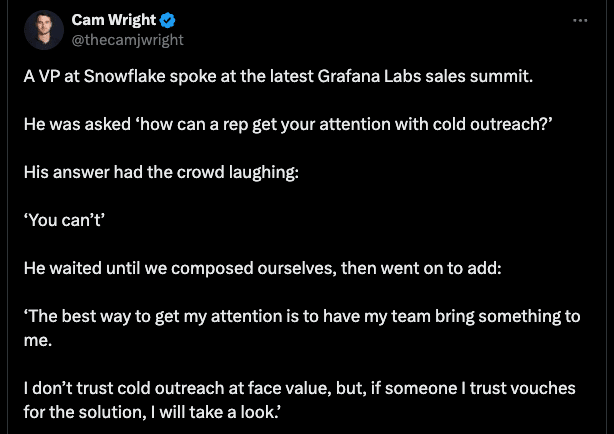
This is the exact reason why most deals are stalled despite having the first meeting with the decision-makers. If the rest of the buying committee don’t know you, and feel your solution creates a risk for their careers, you lose the deal.
Drive pipeline THIS quarter with full-funnel ABM programs.
If any of these challenges sound familiar:
You are aligned in theory with sales but don’t do anything in practice aside from receiving wish lists from sales and sharing with them your marketing plan. In reality, you work in silos and miss the revenue targets and are being pressured by your executives.
You understand that your marketing and sales playbook is broken (mqls, gated content) but despite many attempts you don’t know how to fix it
Your outbound, paid ads and organic pipeline drastically decreased while CAC increased mostly because most of your market is problem unaware and not buying.
You lack brand awareness among target accounts and sales can’t get even a reply.
You clearly see that you’re already behind your revenue targets
We can help.
We’ll develop a custom full-funnel ABM strategy aligned with your resources, budget and stack and execute it together to drive results THIS quarter.
Step 3: Map the buying committee and plan the engagement
For many teams the next logical step is setting up an outbound cadence and launching air cover. Don’t do it.
Before you reach out, tailor your account research to the contacts. Match the account challenges and key initiatives with every buying committee member. Then, thinking about what content (don’t think about formats) can add value and nurture every buyer.
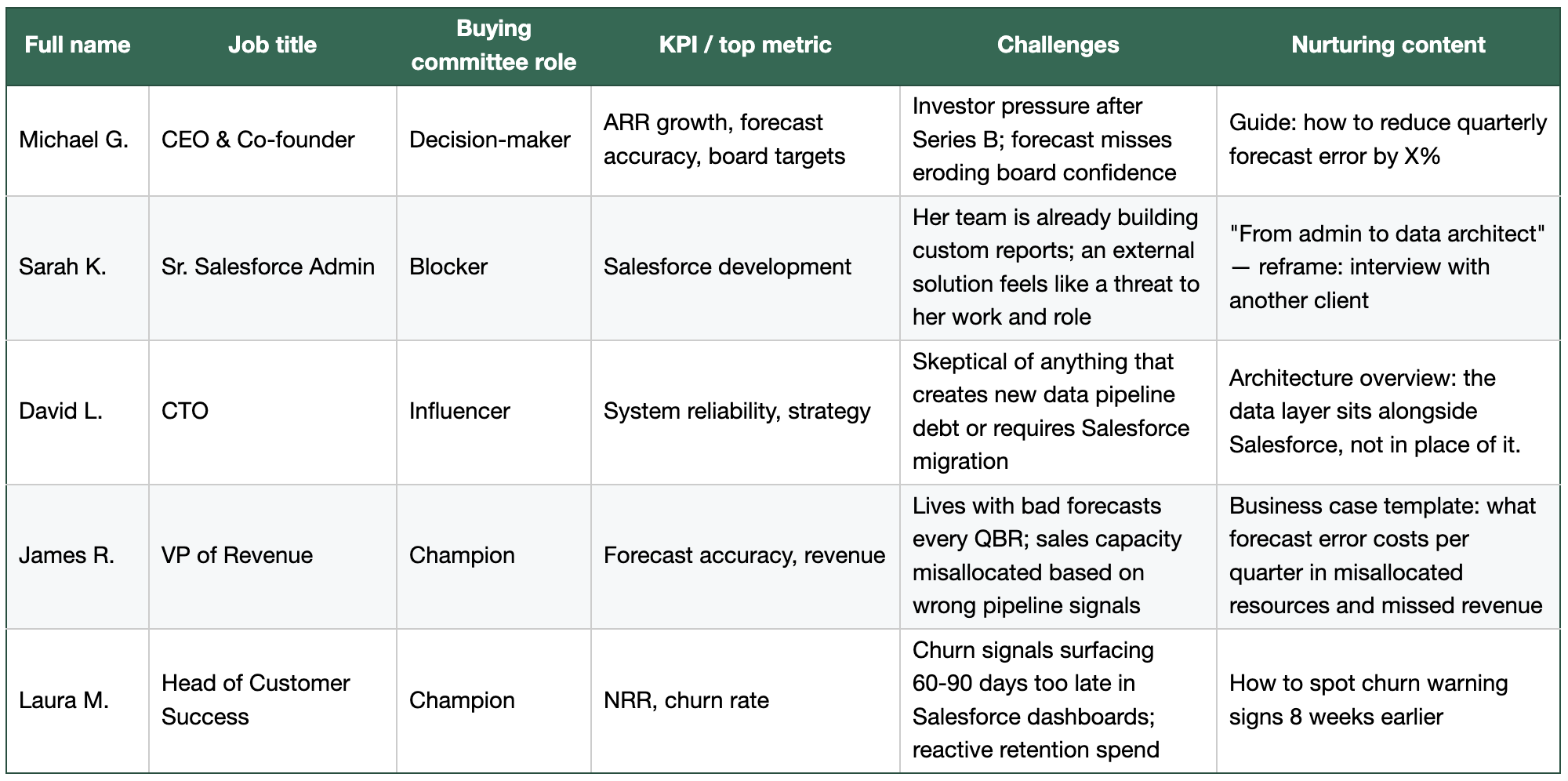
A few things to notice here.
1. The blocker gets as much attention as the decision-maker.
If you bypass Sarah and go straight to Michael, Sarah will surface objections in the evaluation that you haven’t addressed. She becomes a silent dealbreaker. Convert her instead: she goes from admin to data infrastructure owner, and you gain an internal champion.
2. The “nurturing content” column is not a list of your product content.
You brainstorm here what content might challenge the status quo, seed the grain of change, and address the challenge this person is accountable for. For example, James R. doesn’t need a platform overview and map of data layering on top of Salesforce. He needs a document he can bring to the next QBR that justifies investigating a change.
3. “Creating” Champions.
James and Laura face the revenue forecasting and churn issues every single day. They have the business context to build an internal case. Your goal is to show them how to solve their challenge (aka selling the alternative solution) so they can champion your product later internally.
Once you have this map, you have everything you need to build a personalized engagement on the contact level.
Step 4: Create continuous nurturing aligned with the sales cycle length
I mentioned a couple of times that ABM programs often fail because they are treated as 3-weeks outbound cadences amplified by air cover.
Sales don’t get replies, mark the accounts as cold, and move on.
The truth is simple: our selling window doesn’t match their buying window.
The decision-maker you’re targeting isn’t shopping now. The budget for the alternative hasn’t been allocated. The internal business case for switching from DIY to custom data platform hasn’t been built.
Which means that you knocked on the door at the wrong time, and then disappeared.
When you have long sales cycles, you need to develop your account engagement based on continuous nurturing principles. This allows you to maximize value-added touchpoints to stay top-of-the mind, nurture and get into a consideration set.
We combine an account-specific plan for every buyer with the global ABM or Always-On marketing programs. Here is how.
Track 1: Time-based playbooks (global program)
You have planned marketing and sales activities across the quarter that create value-added touchpoints regardless of where the account is in their buying journey. You don’t need a signal to execute them. You need a calendar and a plan.
Coming back to our example, here is how we can integrate some of the Always-on marketing programs:
Month 1: Content collaboration with Laura (Head of CS, champion).
Reach out for a roundup post: “How fintech revenue leaders are rethinking churn prediction.”
Feature her perspective. Distribute to her colleagues. She gets visibility in front of peers, and you get a good reason to connect with others on the buying committee.
Month 2: Webinar invite to David (CTO, influencer).
Topic: “Building a forecasting data layer on top of Salesforce: architecture decisions for fintech companies.” Send 1:1 LinkedIn invite and email follow-up.
Month 3: Account love letter.
A LinkedIn post analyzing the company’s growth trajectory, what the Salesforce architect hire signals about their forecasting ambitions, and a POV on where Series B fintech companies typically hit the ceiling with Salesforce-native forecasting.
Tag relevant people. Send directly to the buying committee: “Wrote something I think is relevant to what your team is building.”
Month 4: Market research invite for James (VP of Revenue, champion).
Ask to contribute with a quote to our 2026 benchmark report on forecast accuracy in fintech.
Feature him. Share the report back. Use it as the reason for the next conversation.
Every touchpoint delivers value. None of them pitch the product. Each one creates a natural reason for the next.
Add to your account plan the week-by-week engagement strategy.
One caveat: I just put all of the examples we’ve discussed above into one table, but you need to spread them across a quarter or longer timeline.
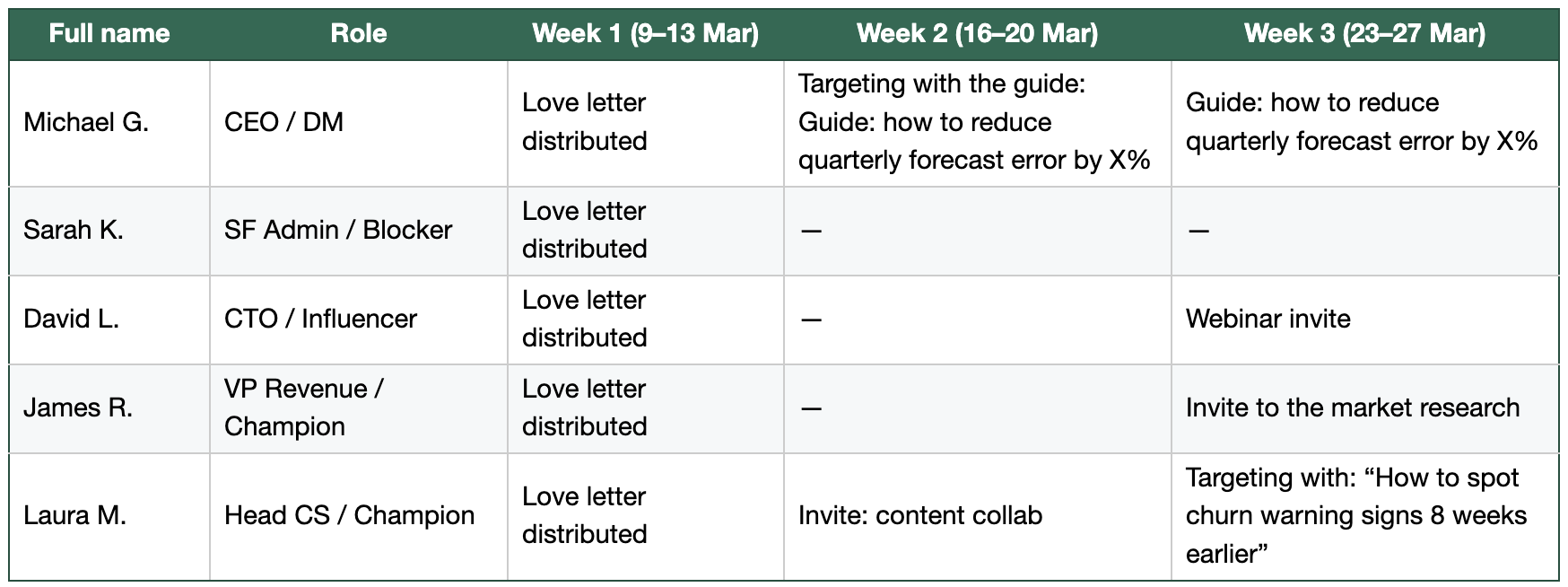
WE SHARE ALL THESE EXAMPLES IN OUR ACADEMY
Track 2: Signal-based playbooks (timely follow-ups)
Whenever you capture a new relevant signal (learn more about signal-based OS here) like new job postings, press releases, LinkedIn engagement, use it as an opportunity to engage.
The combination of time-based and signal-based playbooks is what creates the “I see you everywhere” effect without being pushy. You become relevant because you personalize engagement on the contact level while connecting your messaging to the account’s strategic priorities and problems.
Watch Full-Funnel Live - B2B content flywheels that generate 80% of pipeline.
*If you want to attend the next live episode, sign up here to receive an invite. Usually, we host them every Wednesday at 3:30 pm CET (Central Europe) - 09:30 am ET (Eastern Time).
In this episode of Full-Funnel Live, Vlad and Andrei invited Diandra Escobar, Founder of Distinctiva.io — the content strategist behind B2B brands generating 80% of their pipeline from LinkedIn organic.
With her clients, Diandra replaces content calendars with content flywheels where every piece compounds on the previous one.
One client scaled from $1.2M to $3.6M ARR through LinkedIn alone. Another attributes 80% of leads to LinkedIn organic. Another one reports their newsletters are hitting 60%+ open rates.
We're going to break down exactly how B2B CMOs can implement content flywheels to generate pipeline in 2026.
💡 Tune in to learn:
Why generic “how to” content is dead and what “authority content” actually means
The content flywheel framework: how to build it, what to stop doing, and what to replace it with
How to defend your content flywheel strategy from “why can’t you do it with AI”?
How to track engagement signals from content and hand them off to Sales
How to report content-led growth to a CFO who only speaks pipeline