
🕵🏻♂️ Signal-based strategy
How to convert intent and buying signals into pipeline, not just sales outreach.


Most B2B teams buy intent data tools and immediately route signals to sales as “engaged accounts.”
Sales picks up 3 they already know. Ignore the rest. When you ask “did you follow up?”, the answer is always yes.
But following up ≠ account development.
The real problem is that teams treat every signal as buying intent without connecting it to where the account is in the buyer journey.
A contact downloading your guide is at “I want to learn.” A contact visiting pricing 3x after 2 webinars is at “we want YOUR solution.” (see Demand Generation from buyer’s perspective)
Pitching both the same way burns your pipeline and trains your buyers to ignore you. After running multiple ABM programs with our clients where we integrated signals , we built a 5-step framework to fix this.
In today’s newsletter:
The 3 reasons why teams can’t convert signals into pipeline
5-step process to create a signal-based strategy aligned with the buyer journey
How to evaluate your signal-based strategy: our checklist
A personal announcement:
A few weeks ago I’ve announced I’ve started working on one of my biggest dreams - opening a football academy in Spain. It’s a long-term project. But while working on it, I want to share my experience of raising two young football players, how to support your kids in their sport journey + how do I build an academy.
If you have kids who love sport (especially, football (soccer), sign up here:

and check my two recent articles:
How to find a good football (soccer) coach for individual trainings for your kids
An ex-Barcelona player coaches my son. It changed how I think about youth football development.
SIGN FOR OUR 7TH VIRTUAL FULL-FUNNEL SUMMIT

On 24th-26th March we’re hosting our 7th annual Full-Funnel Summit.
It’s virtual and free to attend, so you can join us from anywhere.
3 days. 15 keynotes from top-notch speakers including Matt Heinz, Ashley Faus, Davis Potter, Justin Rowe and many more.
The recordings will be available only to summit attendees.
Share the event with your team and sign up here!
The 3 reasons why teams can’t convert signals into pipeline.
From my observations, there are 3 main reasons why teams struggle to leverage signals to engage accounts.
1. Prioritizing volume of signals.
When you track 50 signals across 200 accounts, your team ends up doing one of two things: ignoring most of it, or treating everything as a trigger to start an outbound cadence.
I always ask teams: which 5 signals would you bet your compensation on as the strongest indicators that an account is worth pursuing right now?
Most can’t answer.
As a result, they either do nothing with the signals or start the same generic outreach based on the signals aka “Congrats with funding! We help companies like yours…Do you have 15 mins to chat next week?”
2. Treating every signal as buying intent.
Whenever I ask to describe how companies use signals, I usually here:
Marketing prepares a list of engaged accounts and sends to sales → SDR sends a “personalized” message or email referencing the signal → no reply → move on.
There is no judgement and understanding what level of intent the signal means. The teams treat every signal as buying intent, regardless of where the account actually is in the buyer journey.
A contact downloading your thought leadership guide is at stage 1 of their buyer journey: “I want to learn.” They’re discovering content, following brands, sometimes sharing interesting articles with colleagues. They are interested in best practices, not in the solution.
But compare it to a contact who visits your pricing page after attending three of your webinars, with two buying committee members already subscribed to your newsletter?
This account is at stage 3 or 4: “we want a solution like yours” or “we want YOUR solution.” This is a completely different conversation.
But when you treat all signals the same way as a reason to pitch your product, you just train your buyers to ignore your outreach.
3. No ownership of the process.
Here’s what happens in most teams. Marketing looks at intent data, identifies engaged accounts, and shares them with sales: “Here are your 15 most engaged accounts from the last week.”
Sales picks up the 3 they already know. Ignore the rest. When asked “did you follow up?” the answer is “yes.”
But follow-up is not the same as account development.
Real account development requires connecting a signal to:
what we already know about this account from past interactions
what their current strategic initiatives are
what buying committee members we’ve already engaged
what is their buyer journey stage and the level of signal intent
what the appropriate next step (both for marketing and sales) looks like at this stage
*Read our guide how to create 1-1 account plans:

It means you need to have a structured process and somebody owning it. Without it marketing just creates infrastructure to capture signals, transfers the engaged accounts to sales and asks follow-ups. Very similar to MQL handover, but with a new sauce.
BECOME A FULL-FUNNEL B2B MARKETER

Full-Funnel Academy is a comprehensive B2B marketing training and Slack community for B2B marketers who care about revenue and want to move the needle.
Academy includes:
All our B2B marketing courses including ABM playbook, Demand Gen Playbook, LinkedIn Allbound marketing playbook and 11 more courses that aren’t available publicly + all upcoming courses.
Private Slack community to answer all your questions
Personalized learning plan. If you are not sure what skills you’d develop in the first place and how to get maximum from the program, we can create a personalized learning plan accordingly to the time you can dedicate to education.
Behind-the-scenes sessions. See what’s working and what doesn’t work and why on the “behind the scenes” sessions where we review the campaigns we are running for our clients and us.
Learn more and join the academy here.
5-step process to create a signal-based strategy aligned with the buyer journey
You don’t need new technology to develop a signal-based strategy. The fix starts with a 2-hour working session between marketing and sales. We call it a “signal hackathon”.
The goal is to build a shared operating model from scratch. Here is the 5-step process we use.
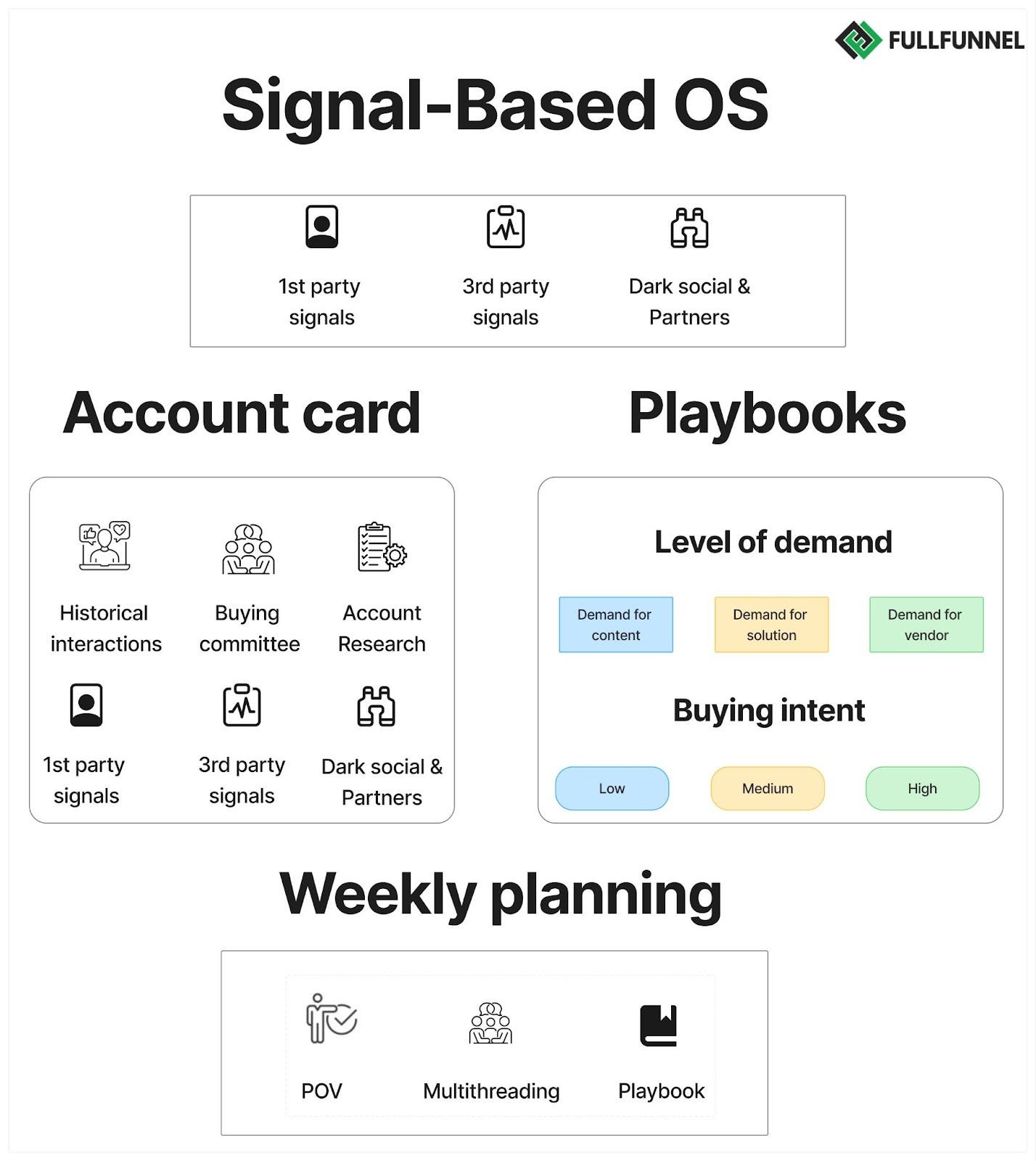
1. Define what signals actually matter.
Start with a blank page and one question: which signals, if we saw them on a target account, would make us both (marketing and sales) say “we need to do something about this account right now”?
Build your signal matrix across 3 categories:
1st party signals — your own data:
Visits to high-intent pages (pricing, case studies, demo)
Webinar signups and attendance, especially product-focused webinars
Newsletter opens and link clicks over multiple weeks
Content consumption in content hubs
Content engagement on LinkedIn (likes, comments, reshares)
3rd party signals — external data:
Hiring announcements for specific roles
Funding rounds or PE acquisitions in the last 6 months
Management changes
Review site activity on G2, Capterra, TrustRadius
Executive interviews where they share new strategic initiatives
Community and dark social signals (the most under-tracked category):
Questions asked by target buyers in communities and forums
Peer recommendations mentioning your category
Engagement with your partners’ events and content
One important note on the third category: you cannot track community and dark social signals with a tool. These require manual processes: someone on your team monitoring the right communities, building relationships with channel partners, and collecting intel from sales conversations.
You can install social listening to track specific keywords on Reddit, LinkedIn, Facebook and X, but you can’t access Slack, Discord, Telegram and WhatsApp groups. This is human work, not software.
*Here is how we did it with TestRail tracking the engagement inside the Ministry of Testing community:
Among all available signals, pick together with sales 3-5 most important signals per category. Our goal is to build a strategy first and create real playbooks instead of diluting the focus. You can expand it once you’ve built the habit of actually using the most important signals.
2. Define the level of demand and buying intent for every signal.
For every signal in your matrix, answer two questions:
What level of demand does this signal indicate?
What is the buying intent level?
We use a simple framework (learn more here: https://fullfunnel.io/demand-generation-for-long-sales-cycles/ )
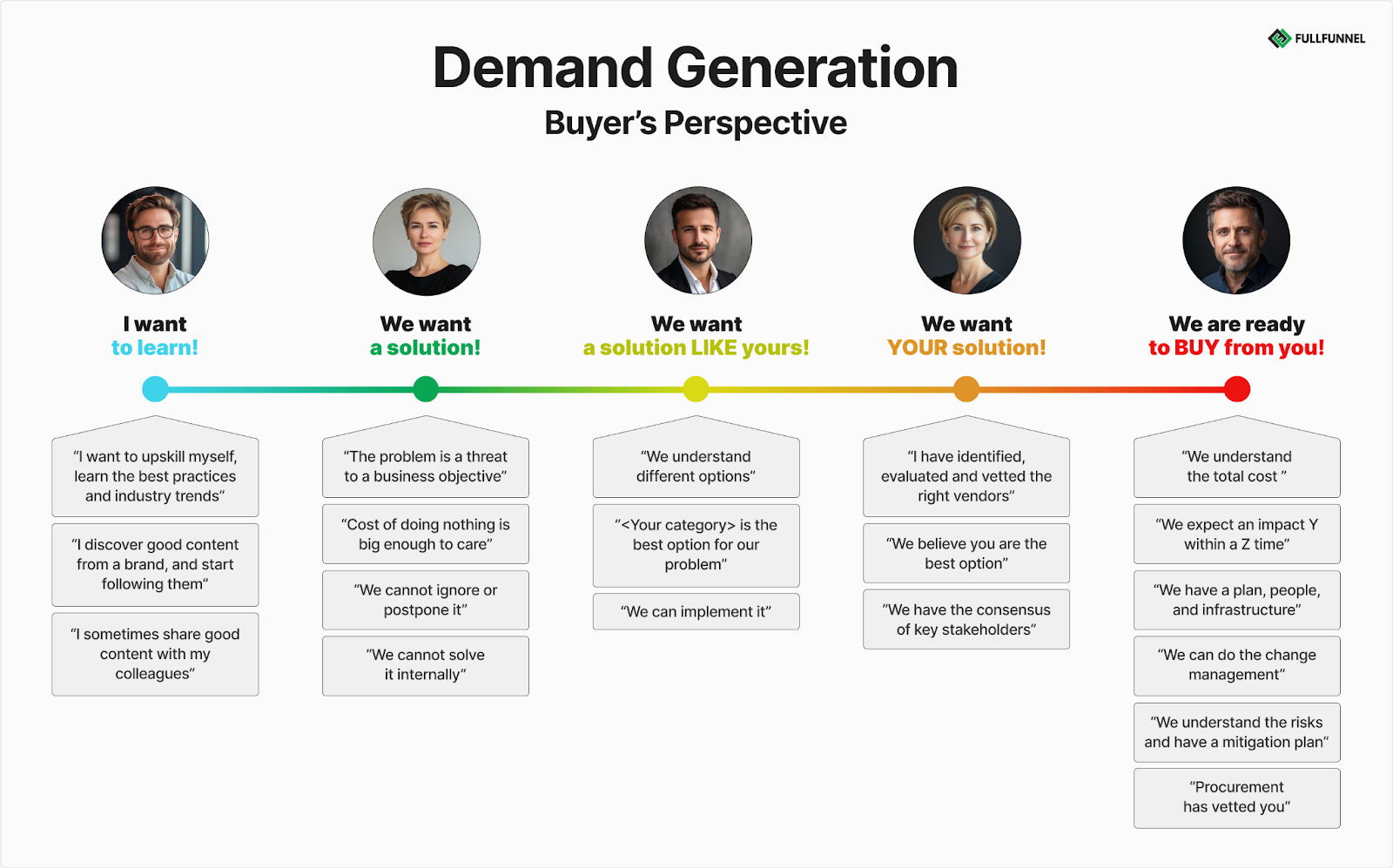
Demand for content (buyer journey stage: “I want to learn”). Buying intent: low/no.
The account is discovering content, following brands, sometimes sharing articles with colleagues. They may not even have a defined prioritized problem yet.
Marketing action: qualify and segment by ICP criteria, add to use-case cluster retargeting. Sales action: connect with an engaged buyer, ask a profiling question, suggest a relevant resource.
Demand for solution (buyer journey stage: “we want a solution”). Buying intent: low/medium.
The buying group has agreed on a top-priority challenge. They’re looking for solutions, evaluating options, not yet vendors.
Marketing action: retarget with thought leadership on the known challenge, enroll in weekly nurturing sequence.
Sales action: enrich buyer data, run account research, collect feedback, ask a profiling question to understand the current stage, suggest a relevant resource or consultation with an internal SME.
Demand for solution like yours / demand for vendor (buyer journey stage: “we want a solution like yours” or “we want YOUR solution”). Buying intent: medium/high.
The account is evaluating vendors or has already started comparing you to competitors.
Marketing action: qualify by ICP, use-case cluster retargeting.
Sales action: if it’s a known buyer, connect with a named champion and suggest a demo. If it’s an unknown buyer, run account research, start multi-threaded engagement, write an account “love letter” or personalized content hub distributed on LinkedIn and by email.
Map every signal in your matrix to one of these levels. Now your team has a shared definition of what every signal actually means, and how to leverage it beyond the sales outreach.
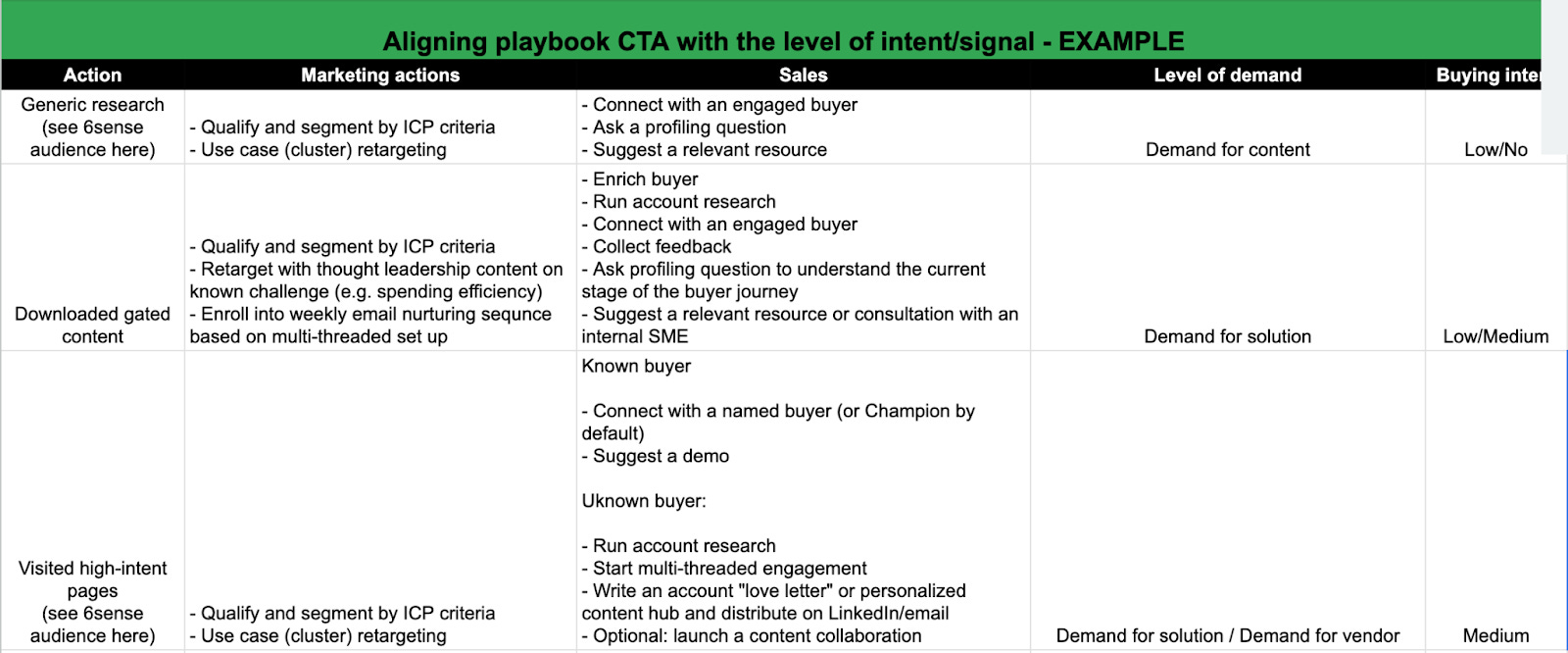
We show how to map these signals in breakdown of playbooks in our Full-Funnel ABM course in our academy.
Outcomes you can expect after implementing the course:
Sales opportunities with the target Tier 1 and Tier 2 accounts, sourced together by marketing and sales
Clear path to revenue targets by applying goal decomposition for different ABM motions and accounts
Sales and marketing alignment on target accounts, buyers, warm-up, activation campaigns and joint playbooks
Clear ICP that replicates your best customers and is accepted in your organization for account qualification, list building and lead routing
Improved brand awareness and positioning of your solution as a natural choice to target accounts and buyers
Custom playbooks including warm-up and activation programs to ensure target accounts and the buying committee members are aware of your product and offering
Increased volume of responses from the target accounts
Realistic ABM budget and forecast based on the inhouse benchmarks and sales pipeline velocity instead of gut feeling
Quickly (6-12 weeks) implemented pilot program leveraging ready-to-use playbook templates and reports with the tangible outcomes you can present to your stakeholders to justify the investment and to get further support
A significant lift in the marketing ROI
Learn more and join the academy here.
3. Create a holistic account card.
Most teams skip or never think about this step. Their intent and engagement data lives in multiple platforms, which is the exact reason why most teams deal with account blindness. They can’t connect the signal to the historical interactions with the target account, collected insights, and can’t make sense of the new signal.
Account card includes:
Account research
Buying committee
Historical interactions
All captured signals
The goal is to have a complete overview of an account to make sense of the signal and define the best next step. Not just blindly act on a signal assuming it means the buying intent.
Here is how you can integrate signals into existing account cards in your CRM.
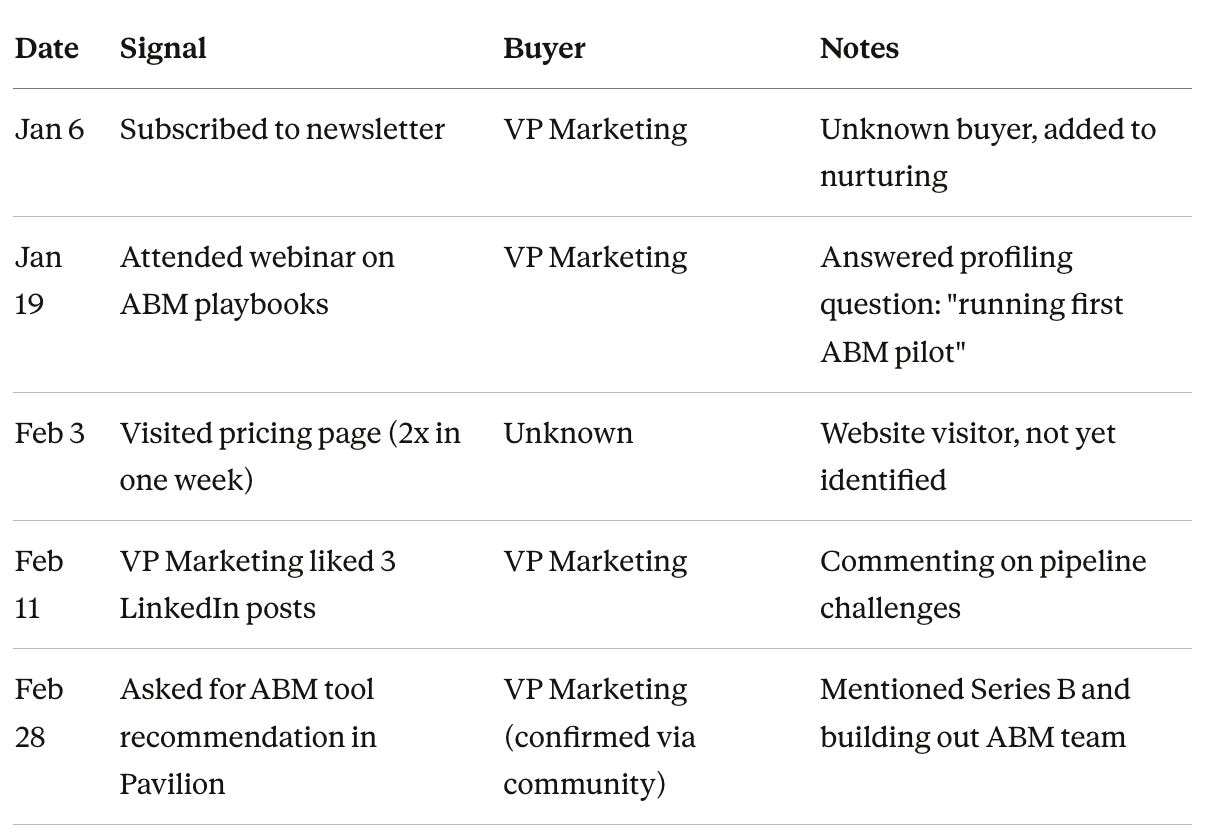
If you look at one signal in isolation (e.g. liked a LinkedIn post about ABM), you might think the buying intent is low, and the buyer is just interested in the content.
But if you look at the full engagement map, you’ll clearly see that this account with a named buyer is moving from “I want to learn” to “we want a solution like yours,” with a clear business trigger (Series B). This account moves from Cluster ICP to Active Focus (see our account prioritization framework) and requires involving AE or VP of Sales for further planning and activation.
The account card is the starting point for a 1:1 account plan. When you have this history, you don’t start from zero every time a new signal fires. You already know what they care about, who’s engaged, and what conversation to have next.
Keep it in a Google Sheet to start. Once the model works, operationalize it in your CRM.
4. Design the standard playbooks for the selected signals.
Include 3 scenarios:
Known account with an engaged champion
Unknown account, no relationship.
Known company, new unknown buyer
Each of these scenarios requires a different playbook.
Here are some examples.
Scenario A: Known account, existing relationship with a champion.
Let’s say your champion signed up for your upcoming webinar. You already know them and had some conversations. You have context on where they are.
Instead of sending a generic “saw you registered” email, ask about the status of their strategic initiative. Connect it to the webinar as an opportunity to understand the current context.
Here’s an example of the message I sent to a Champion working for our strategic account.
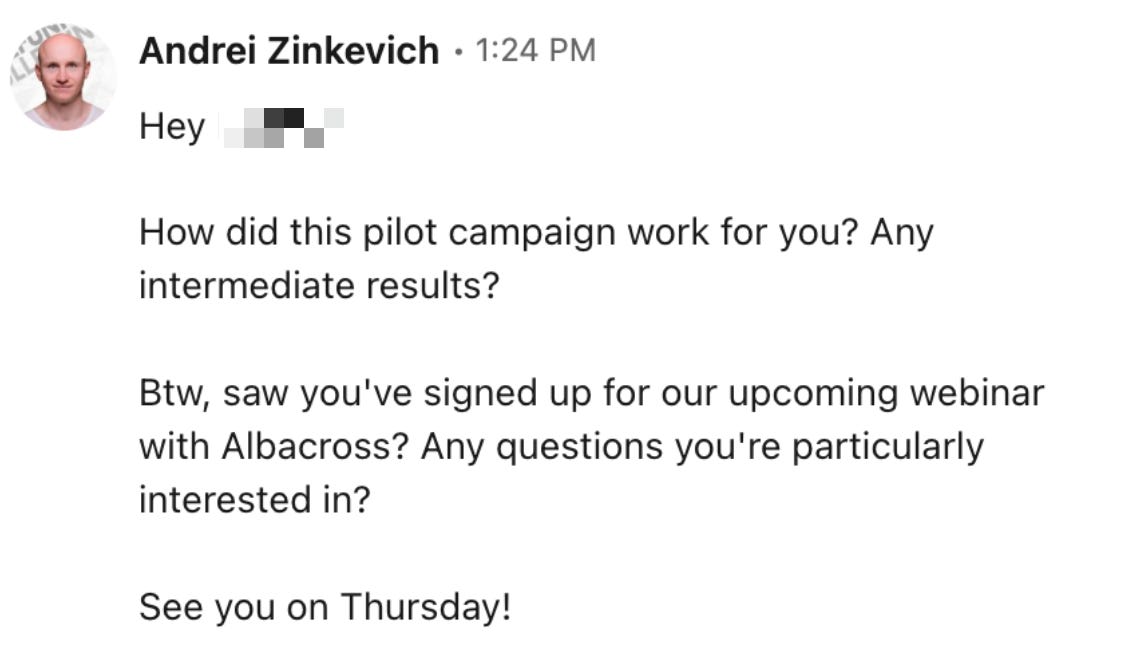
Two sentences. No pitch. Picks up the thread of an existing relationship.
Scenario B — Unknown account, no existing relationship.
Someone from a target account visited your blog. You don’t know them. They don’t know you.
Instead of pitching with “Saw you visited our website, we help…”, start a conversation trying to understand their current interest.
Here is an example.
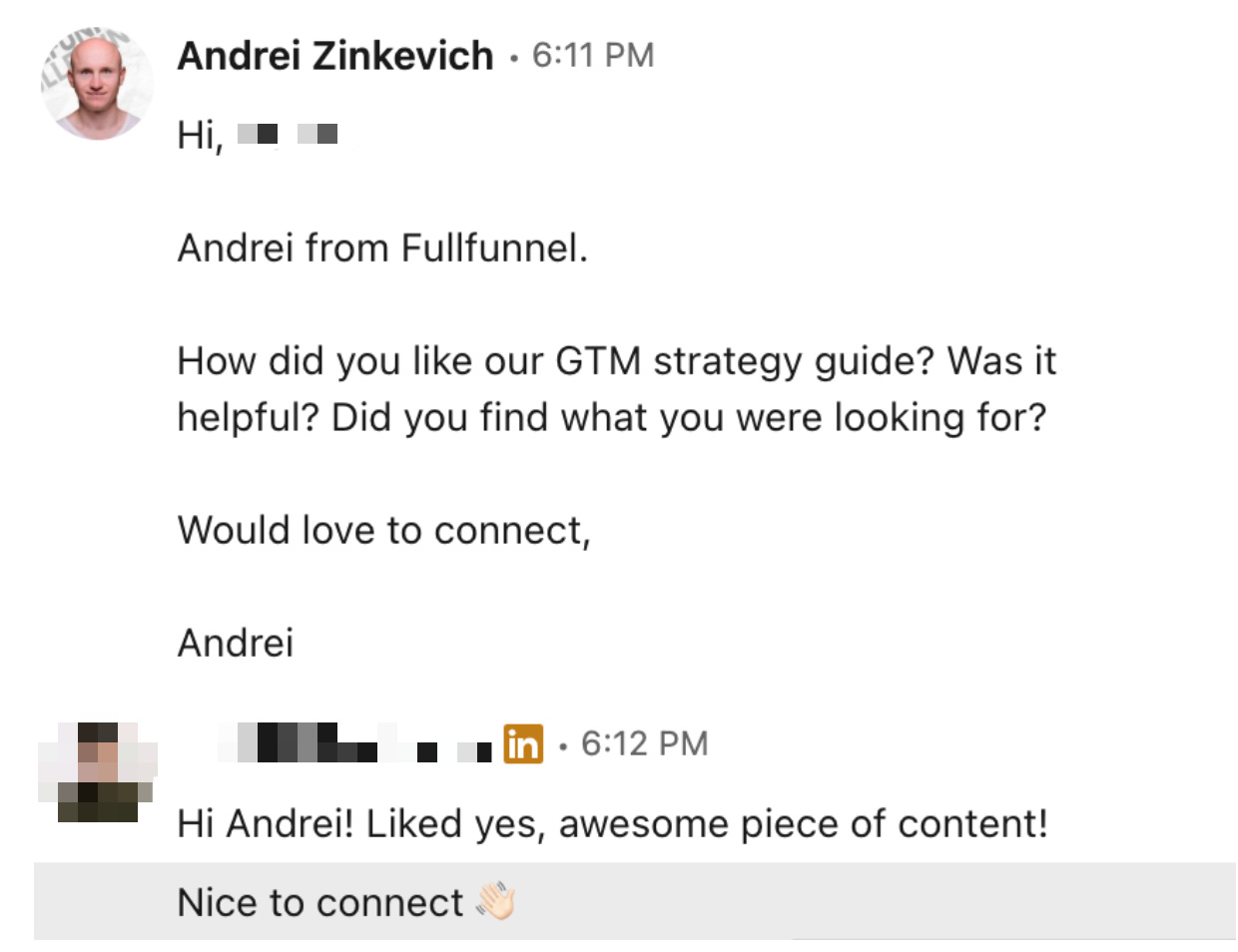
The goal is a reply, not a demo.
Once they reply, you have a conversation. From a conversation, you build a relationship. From a relationship, you eventually earn the right to ask about their initiatives.
Scenario C — Known company, new known buyer without a relationship.
This is the most common scenario most teams handle wrong.
A new contact from a target account you’re already working engages with your content. The worst possible action you can do is to start a parallel outreach sequence to this new contact.
Instead of immediately pitching a new contact, use the signal as an opportunity to learn more about the level of intent from your Champion. A simple message you can send is “I noticed someone from your team engaged with our ABM playbook content, do you know who owns ABM in your org?”
When you hear back, ask for a warm intro to the right person. A signal on a new contact at a known account is intelligence, not a lead. Treat it that way.
WE SHARE ALL THE SCRIPTS AND EXAMPLES OF HOW TO CREATE DIFFERENT SCENARIOS IN OUR FULL-FUNNEL ABM COURSE
5. Add signal review to your weekly pipeline review sync meeting.
We already covered the importance of weekly pipeline review sync meeting. Reviewing signals and planning next actions with the accounts is a part of the agenda. But to make it work, you need to define somebody who’ll own the process. Don’t expect your reps will act simultaneously or based on Slack notifications.
The person who owns the process, needs to:
Create a system to capture signals
Qualify all new accounts
Make a list of an engaged accounts to review at the upcoming sync meeting
During the meeting, the process owner presents the engaged accounts and discusses with sales:
What does each signal tell us about their buyer journey stage, based on their full history of interactions with us?
Which accounts do we move between lists (Cluster ICP → Future Pipeline → Active Focus)?
What is the agreed next action per account, and who owns it by when?
Keep in mind: the goal is to make a plan of actions for every account, not just “I’ll work on them”. This is when signals stop being data and start becoming a fuel to generate pipeline.
Drive pipeline THIS quarter with full-funnel ABM programs.
If any of these challenges sound familiar:
You are aligned in theory with sales but don’t do anything in practice aside from receiving wish lists from sales and sharing with them your marketing plan. In reality, you work in silos and miss the revenue targets and are being pressured by your executives.
You understand that your marketing and sales playbook is broken (mqls, gated content) but despite many attempts you don’t know how to fix it
Your outbound, paid ads and organic pipeline drastically decreased while CAC increased mostly because most of your market is problem unaware and not buying.
You lack brand awareness among target accounts and sales can’t get even a reply.
You clearly see that you’re already behind your revenue targets
We can help.
We’ll develop a custom full-funnel ABM strategy aligned with your resources, budget and stack and execute it together to drive results THIS quarter.
How to evaluate your signal-based strategy: our checklist
We ask 5 questions to evaluate the efficiency of the signal-based strategy. If you answer NO to 3 or more of these questions, you don’t have a strategy. Your stack is just generating noise, not pipeline. Here is the checklist:
1. Have marketing and sales defined together 3–5 most important signals per every category: 1st party, 3rd party, and community/dark social signals?
2. Is every signal in your stack mapped to a buyer journey stage and demand level, so your team knows what it means before they act on it?
3. Do you have an account card or equivalent that shows signal history over time per account, not just a separate signal?
4. Do you have documented playbooks for known accounts vs. unknown accounts vs. known accounts with the new buyers, not just “personalized outreach” templates for every signal?
5. Do you have regular pipeline review sync meetings where somebody presents the engaged accounts and where you plan as the team next concrete actions for every engaged account?
If you answered NO to the first two, start there. Without a shared definition of which signals matter and what they mean, all other points make no sense.
The resources I mentioned in this newsletter:
Watch Full-Funnel Live - How to Use Signals in ABM: From Cold Outreach to Real Engagement.
*If you want to attend the next live episode, sign up here to receive an invite. Usually, we host them every Wednesday at 3:30 pm CET (Central Europe) - 09:30 am ET (Eastern Time).
In this episode of Full-Funnel Live, Vlad and Andrei break down what top ABM programs get right.
💡 Tune in to learn:
Why 1st party signals are the real ABM gold—and how to generate them
How to build a sequence of value-added activities that move target accounts from cold to connected
What high-performing ABM programs actually do: from LinkedIn “account love letters” to expert roundups and content hubs
The mix of 1:Many, 1:Few, and fully personalized content that keeps you top of mind with buying committees
Why 3rd party data is only as valuable as your existing account engagement